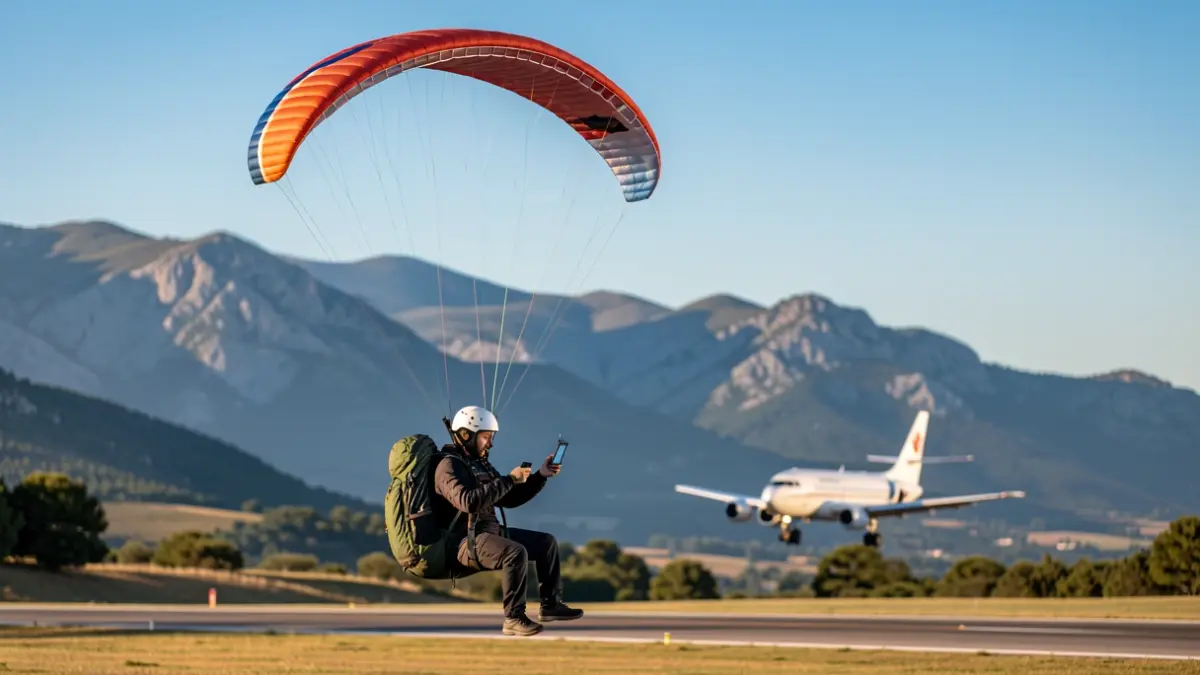
The new device relies on a mobile application that will enable real-time geolocalization of paragliders, thereby facilitating the safe management of aircraft operating under instrumental flight rules (IFR). The primary objective is to significantly reduce the interruption time for paragliding activities, which currently can last up to two and a half hours, to an interval of fifteen to thirty minutes. This improvement is a long-standing demand from the sector, which has seen its activity decrease by more than half in recent years.
Paragliding activity in Organyà is a key economic driver for the municipality, supporting hotels, restaurants, and flight schools. However, the increase in air operations at the Andorra-La Seu d'Urgell airport, which recorded a record 1,063 operations last July (an 83% increase from the previous year), has complicated departure planning. One-third of these operations are for public services such as emergencies.
To address this situation, Aeroports de Catalunya has implemented the SafeSky application. This system will allow the airport's control tower to detect the presence of paragliders connected to the network. Practitioners will need to carry the application on their mobile phones, sharing their geolocation and altitude. A receiving antenna has been installed at the Organyà launch site to capture air traffic signals like ADS-B and relay them to the platform.
Currently, paragliding jumps are halted for up to two hours before the arrival or departure of a flight. The new system promises to shorten this waiting period. According to Oscar Madrid, the airport's director, there will be a 15 to 30-minute window during which the control tower will notify the paragliding coordinator of the presence of air traffic. Paragliders will need to vacate the instrumental maneuver area, either by moving to designated safe zones or by landing.
The protocol distinguishes between visual and instrumental flights. With visual flights, coexistence is possible without limitations, maintaining a safety margin of 500 feet from aircraft (paragliders at 6,000 feet and visual flights at 6,500 feet). Coordination will primarily be necessary for instrumental flights, such as the regular flights operated by Air Nostrum. A coordinator will be stationed at the launch site to ensure the application's use and an emergency protocol for non-compliance.
Once the tests are completed, Aeroports de Catalunya will submit a technical report to the State Aviation Safety Agency (AESA) for validation. Oscar Madrid expects authorization in early 2027. If approved, Catalonia would be a pioneer in Spain for this technology, with the potential for export to other airports. Airports in Austria or Switzerland already use similar systems.
The paragliding sector welcomes the measure, although it expresses some skepticism regarding the anticipated increase in private jets. Fernando Martínez, director of the Parapent Barcelona school, acknowledges the improvement in reducing waiting times but points out that they still have to land an hour before each air operation. The economic impact has been severe, with the inability to accept new bookings and conduct classes on weekends.
Martínez warns that the improvement might be insufficient if the airport continues to grow, especially with the rise of air taxis and private jets operating under instrumental flight rules, which could keep limitation times high.