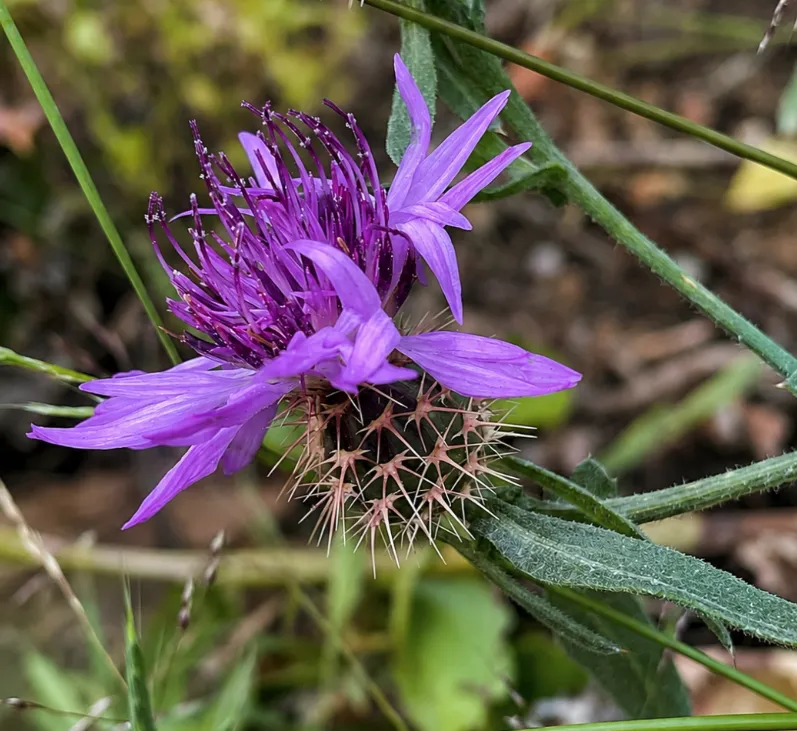
During the sixth edition of the Flora Biomarathon, held from May 15 to 18, 2026, scientists located these plants near the National Art Museum of Catalonia (MNAC). The presence of Centaurea seridis in such an altered and busy environment was surprising, given its limited distribution in Catalonia.
The discovery was further enhanced by finding individuals with intermediate morphological characteristics between Centaurea seridis and Centaurea aspera, a more common species on the hill. These hybrids, known as Centaurea × subdecurrens, are triploid and sterile, and their northernmost known hybridization zone was previously on the coast of Castellón. The Montjuïc finding represents a significant northward expansion of their known distribution.
To confirm the identity of the specimens, researchers combined morphological study with genome size estimations, providing new data on this hybrid and C. seridis. The study documents the only known location of C. seridis in Barcelona supported by herbarium material and cytogenetic analyses.
This discovery highlights the value of urban spaces for biodiversity research and the importance of citizen science initiatives, like the Flora Biomarathon, in expanding knowledge about species distribution. It also underscores the role of herbaria in documenting biodiversity.
The results of this research have been published in the scientific journal Collectanea Botanica.