Minister of Research and Universities, Núria Montserrat, highlighted the Government's responsibility to provide the Catalan university system with the stability, resources, and tools needed to face profound transformation and ensure it remains a space for knowledge generation serving society. Montserrat pledged to establish a university funding model that is "sustainable, stable, and sustained over time," as well as to support digital transformation, the integration of artificial intelligence, talent attraction and retention, generational renewal, improvement of teaching quality, knowledge transfer, and especially internationalization.
The minister advocated for the public university's role as a "social elevator" and emphasized the universities' "extraordinary responsibility" to strengthen the use of Catalan in teaching, research, and knowledge transfer, while building centers that are "increasingly international and multilingual," stating that these objectives are not contradictory.
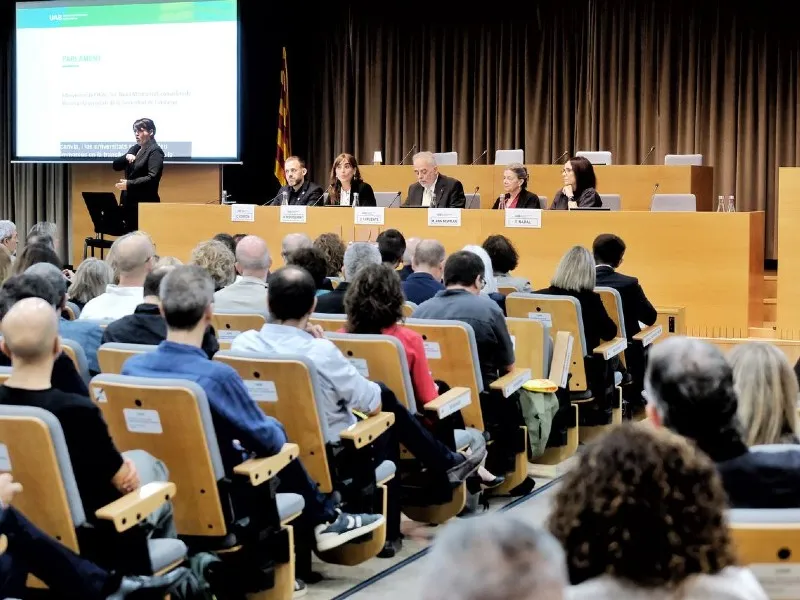
These statements were made during the inaugural ceremony of the 2026-2027 academic year for the Catalan university system, held at the Autonomous University of Barcelona (UAB), presided over by rector Javier Lafuente. The ceremony also included the presentation of the Jaume Vicens Vives awards for university teaching quality.
The Department of Research and Universities has implemented measures to facilitate university access for disadvantaged students. A 1% reservation of places has been introduced for students with socioeconomic vulnerability, attracting 586 applications. The maximum age for tutored and formerly tutored students has also been extended to 30 years, with 86 applicants.
University fee reduction conditions are maintained, with a single price of 17.69 euros per credit for bachelor's and qualifying master's degrees, and a 30% reduction for non-qualifying master's degrees (19.37 euros/credit). Additionally, single-parent families will now receive the same fee exemptions as large families, benefiting 78,550 current titles.
For the 2026-2027 academic year, 556 bachelor's degrees, 696 master's degrees, and 252 doctoral programs will be offered. Catalan universities hosted over 300,000 students in the previous academic year (2025-2026).
The new program includes 34 new degrees (9 bachelor's, 21 master's, 4 doctorates). Notably, new Medicine degrees are being introduced at the Universitat Ramon Llull (URL) and the Universitat Abat Oliba (UAO-CEU), along with an increase in places at the Universitat de Vic-Universitat Central de Catalunya (UVic-UCC). A pioneering system of condonable loans for Medicine students at UVic-UCC has been approved.
In the field of biomedicine, the Bachelor's degree in Biomedical Engineering is being launched at the Open University of Catalonia (UOC). In ICT, the interuniversity degree in Technologies and Management of Agri-food Companies (coordinated by the UPC) stands out.
Digital transformation and artificial intelligence are driving significant changes in the university system, with an increase in degrees related to AI, data science, and cybersecurity.
Internationalization is a strategic focus, with 214 programs offered entirely in English (26 bachelor's, 163 master's, 25 doctorates) and 53 programs accredited with the Erasmus Mundus label.
Catalan universities continue to promote dual degree options, with 15 programs currently offering this modality, combining academic training with practical professional experience.
The Plan for Strengthening Catalan in the university system has achieved 83% of its objectives. The new proposal for the 2027-2030 period is under development and will extend to research centers.
At the inaugural ceremony, the Jaume Vicens Vives awards for teaching quality and the M. Encarna Sanahuja Yll mentions for excellence in gender perspective were presented. Among the individual awardees are Amalia Creus Quinteros (UOC), Cristina Petreñas Caballero (UdL), and Miquel Àngel Prats Fernández (URL).
In the collective category of the Jaume Vicens Vives awards, projects from the UOC, the International University of Catalonia (UIC), and the Rovira i Virgili University (URV) were recognized. The M. Encarna Sanahuja Yll mentions were awarded to professor Pilar Rivas Vallejo (UB) and the Antígona research group (UAB).