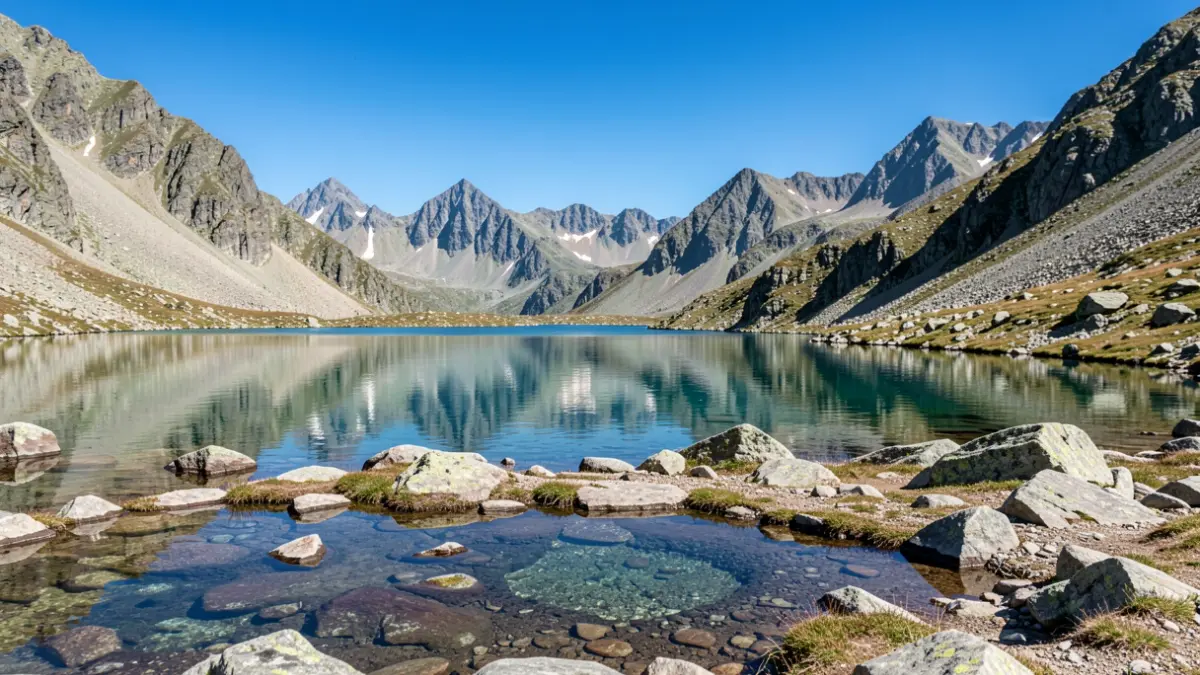
The catalog, published in the scientific journal Geoscience Data Journal, details information such as the surface area, depth, and basin of each water body. It also includes official names, variants, and historical denominations, assigning each element a georeferenced identification or 'DNI' to facilitate cross-border scientific study.
The initiative was led by CREAF in collaboration with CSIC, the Center for Advanced Studies of Blanes (CEAB), the University of Barcelona (UB), and the Autonomous University of Barcelona (UAB). According to Jordi Catalan, a researcher at CSIC and CREAF, georeferencing is crucial for avoiding confusion in scientific studies and enabling public access to the information.
The work addresses the complexity of toponymy, collecting original names and variations due to cartographic errors, pronunciation, or the consolidation of denominations. An illustrative example is that of the Plan and Cabidornats lakes in the Aran Valley, where denominations have been interchanged in official cartography.
The catalog also documents linguistic and phonetic variations, such as the forms Redondo, Redó, or Redon for the same water body, reflecting historical and official changes, like the Aranese 'Redon'. It also details the generic terms used: 'estany' in Catalan, 'estanh' or 'lac' in Aranese, and 'ibón' in Aragon for high-mountain lakes.
The inventory highlights the richness of aquatic ecosystems, including small temporary ponds of just a few square meters that host organisms like anostracans, crustaceans adapted to survive dry periods through resistant eggs. These poorly studied habitats hold significant ecological interest.
Among the most notable lakes mentioned are Certascan, one of the largest in Catalonia with over 60 hectares, and Cregüeña, one of the deepest in the Pyrenees at over 100 meters. Lac Redon is also one of the most studied high-mountain lakes globally, with approximately 105 scientific articles published.
The research, which includes the participation of Meritxell Batalla from CREAF, emphasizes the importance of maintaining long-term study series to analyze the response of lacustrine ecosystems to environmental and climatic changes, as well as to historical human impact.