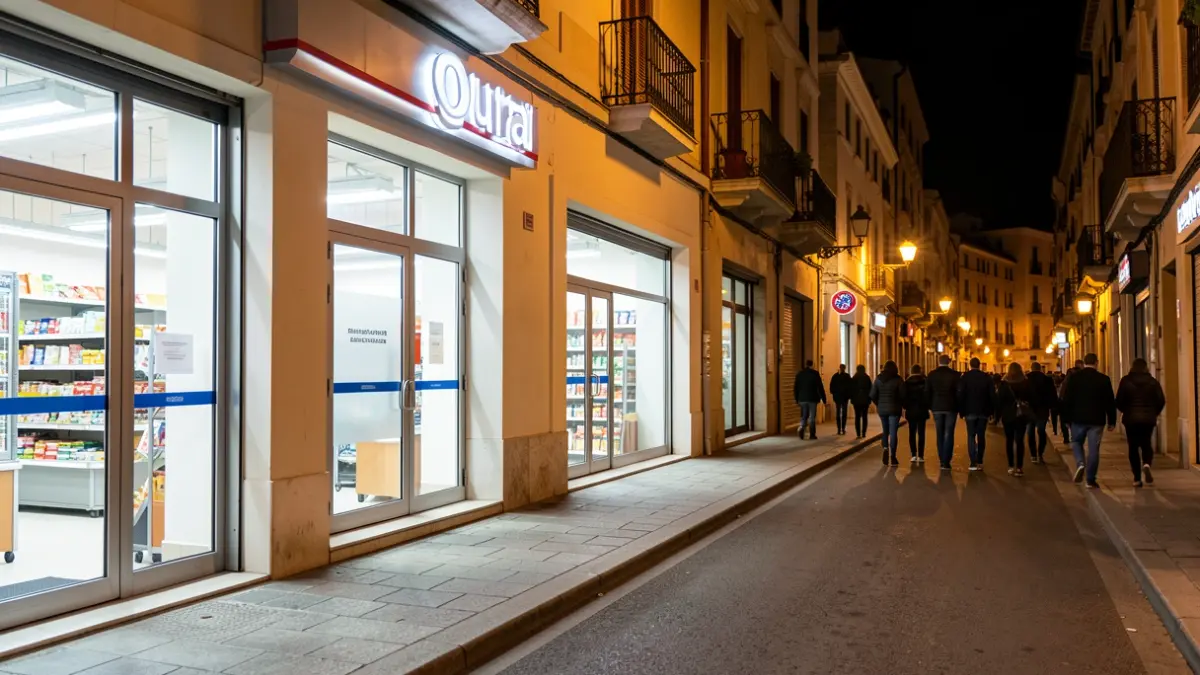
The Barcelona City Council has implemented a temporary suspension on granting new licenses for 24-hour food establishments. This measure, published in the Official Gazette of the Province of Barcelona, will last for one year and aims to give the council time to develop specific regulations for the entire city.
The suspension affects various types of establishments, including food stores, self-service shops, and mini-supermarkets of different sizes, as well as convenience stores. These premises were able to operate without time restrictions thanks to a ruling by the Constitutional Court, allowing them to operate outside the limits of Catalan regulations, particularly those under 300 square meters. Municipal markets are explicitly excluded from this suspension.
This decision also halts the processing of construction notifications for the establishment or expansion of these types of businesses. Currently, Barcelona has approximately 1,300 such establishments, primarily selling daily food products. Since 2015, over 1,250 licenses have been granted to mini-supermarkets, averaging 123 new openings annually.
The municipal government justifies the measure by the proliferation of these businesses, which, according to the council, has led to coexistence problems in some city areas, especially in densely populated residential zones or those with high tourist pressure. The new regulations aim to protect local businesses, preserve commercial diversity, and prevent saturation or commercial monoculture in certain areas. The districts of Sant Martí and Ciutat Vella, which already have recent regulations, will not be affected.
In parallel, the City Council will intensify its inspection efforts. In 2024, significant inspections were carried out, including one in the Eixample district with 112 premises reviewed. The municipal report indicates a high number of violations, including license requirements, public health, waste management, labor matters, and tax issues, as well as urban planning and landscape incidents. In total, 2,880 routine actions have been recorded, resulting in provisional closures, orders for restitution, sanctions, and coercive fines exceeding 440,000 euros.