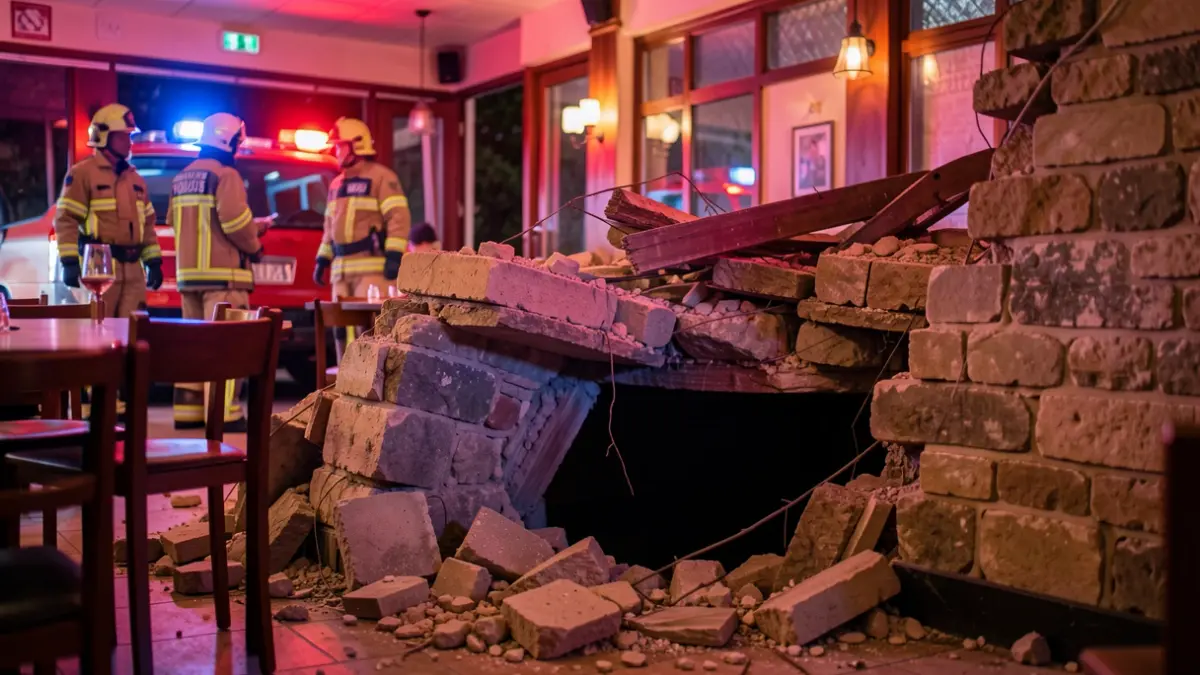
Tension has gripped Sant Gervasi de Cassoles street, at number 56, where a wall collapse inside the Sant Gervasi restaurant has led to the evacuation of buildings 54, 56, and 58. Firefighters and the Guàrdia Urbana have been present since early morning, when a sinkhole on the parallel street, Teodora Lamadrid, caused by the L9 construction, had already raised alarms. This incident has made many, including journalists who witnessed the Carmel collapse twenty-one years ago, relive that tragic event.
Official sources from the City Council and the Generalitat have assured that the situations are not comparable. Currently, eight blocks with approximately 93 homes have been evacuated. Mayor Jaume Collboni has confirmed that residents will not be able to return home tonight and that the situation will be reassessed on Wednesday. No injuries have been reported, and the City Council has assisted 85 affected residents.
The sinkhole, about eight meters in diameter, is located inside the Verona pizzeria, at number 3 Teodora Lamadrid. The owner of the establishment, Domingo Finez, well-known in the Sant Gervasi-Bonanova neighborhood, explained that he discovered the problem in the morning upon arriving at the business. The incident occurred during metro construction.
The Minister of Territory, Sílvia Paneque, and Mayor Collboni have pointed to an "eventual soil movement" as the most probable cause. Since early afternoon, workers have been busy filling the hole with concrete, a task expected to last until dawn. The head of the Barcelona Firefighters' shift, Gerard Pradas, confirmed that stabilization work is progressing and the area is expected to be consolidated by Wednesday.
A resident of Sant Gervasi de Cassoles street, Núria, recalled that on May 28th, a section of the sidewalk in the area was lifted, cordoned off, and later repaved. Minister Paneque has denied any connection between that incident and the current sinkhole. The Generalitat has also inspected cracks in two buildings on Sant Gervasi de Cassoles street, one of which is a convent, noting that some cracks predated the construction work.
Mayor Collboni emphasized that affected residents "will have to sleep elsewhere" tonight. The City Council will provide accommodation for those in need. Residents can enter their homes accompanied by Firefighters to collect essential items. The territorial head of CUESB, Merche Cuesta, indicated that 85 people have been assisted, although it cannot be confirmed if this is the total number of affected individuals.
“"The case has nothing to do with the Carmel collapse."
The Head of Geotechnics and Underground Works of the Generalitat, Laura Carrasco, sought to reassure residents, stating that the sinkhole is located over "an already built, concreted, and therefore consolidated tunnel." She reiterated that the current construction method differs from that used in the Carmel collapse in 2005, where the 12-meter tunnel boring machine acted as a shield, preventing collapses. The tunnel boring machine is currently about 12 meters ahead of the hole.
Despite official assurances, comparisons with the Carmel disaster, which occurred on January 27, 2005, are inevitable. On that day, a sinkhole swallowed a garage and a building, leading to the evacuation of nearly 1,300 people, the closure of 230 businesses, and the demolition of four more buildings. The incident caused a social and political crisis in Catalonia and changed public works execution methods. In that context, the then President of the Generalitat, Pasqual Maragall, accused Artur Mas of illegal commission collection in public works, famously stating: "You have a problem, and that problem is called 3%".