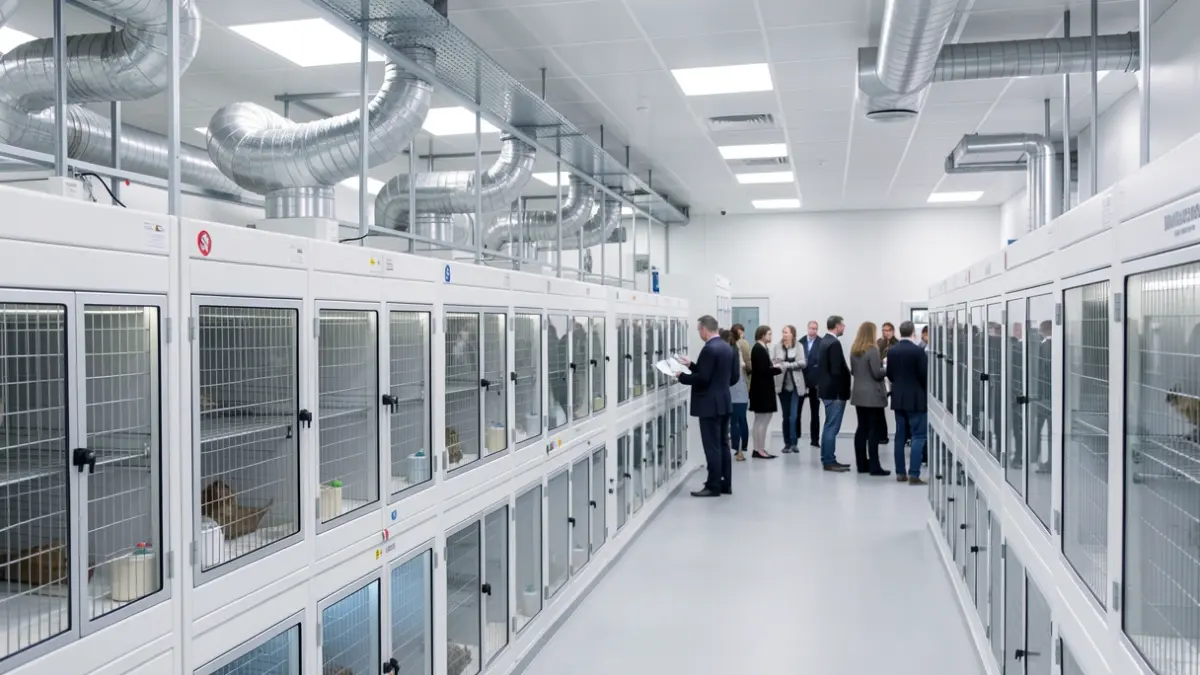
The Centre for Comparative Medicine and Bioimage (CMCiB), affiliated with the Germans Trias i Pujol Research Institute (IGTP), has increased its support capacity for biomedical research by creating a new mouse housing facility and renovating animal accommodation infrastructure. These improvements aim to enhance service capacity, strengthen safety and biocontainment, improve animal welfare, and optimize work environments for health research projects.
The new facility was created by converting an area previously used for zebrafish research. This adapted space includes a new rodent housing area with an associated laboratory, which will accommodate projects in fields such as oncology, immunology, and infectious diseases. Its proximity to conventional experimental spaces optimizes workflows and better integrates animal housing with research activities.
With this expansion, the CMCiB significantly increases its overall capacity, able to house up to 12,000 mice distributed across three specialized areas: conventional, barrier, and biosafety level 3 (BSL3). This diversity of spaces allows for the adaptation of housing and experimentation conditions to the specific requirements of each project, adhering to applicable quality, biosecurity, and animal welfare standards.
Rosa Ampudia, head of the Barrier and Conventional areas at CMCiB, explains, "This expansion allows us to grow sustainably, providing researchers with new spaces and technologies that increase our support capacity. At the same time, we have taken the opportunity to modernize equipment and continue advancing in key aspects such as biosecurity, animal welfare, and process efficiency."
Concurrently, a technological renovation of the accommodation systems in the conventional and BSL3 areas has been carried out. The incorporation of new ventilated cages and associated equipment enhances the protection of both people and animals, as well as the facility's biocontainment and biosecurity levels. These new cages are designed to improve animal welfare and facilitate observation by technical and veterinary teams.
Salvador Pérez, head of Infrastructure at CMCiB, highlights, "One of the most significant aspects of this project is that all actions have been planned and executed while fully maintaining the center's activity. The works, space adaptations, and installation of new equipment have been carried out without interrupting ongoing projects and minimizing any impact on the animals." This continuous adaptation ensures that research can progress as the facilities evolve.
Through this expansion, the recovery of underutilized spaces, and the technological renovation, the CMCiB consolidates its capacity as a scientific infrastructure supporting biomedical and translational research. The center, focused on preclinical research and bioimaging, operates under the principles of responsible research and animal welfare, in accordance with Directive 2010/63/EU.