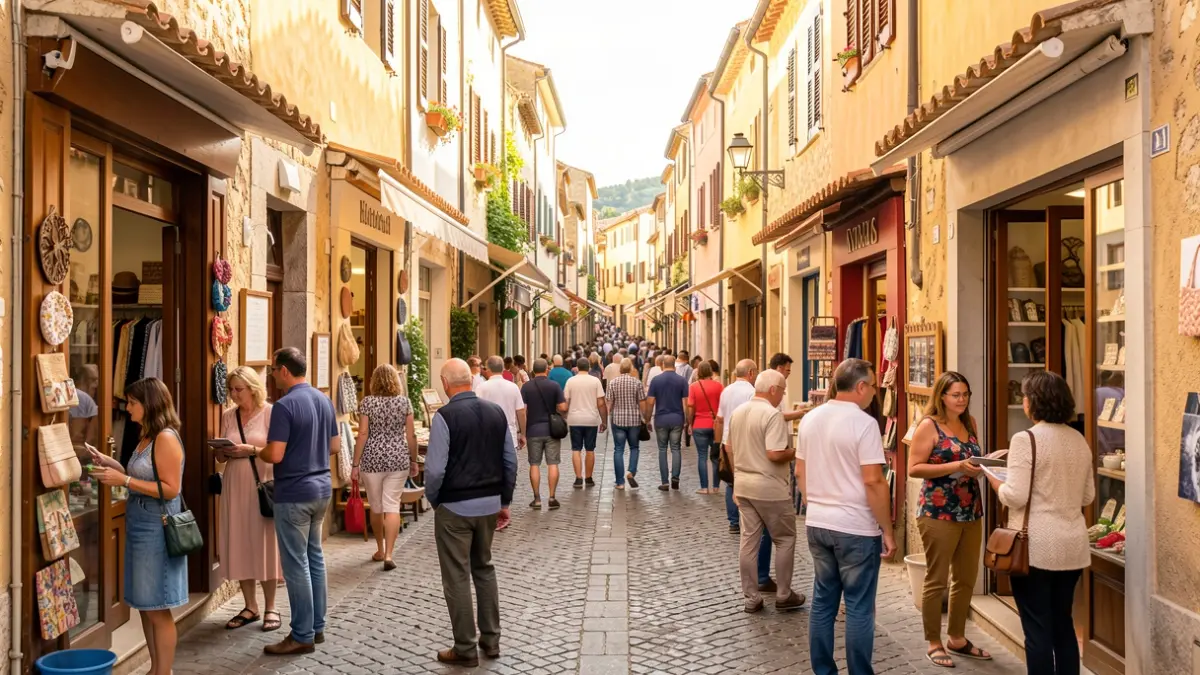
Catalonia has seen a loss of nearly eleven thousand small businesses in the last decade. Faced with this trend, the association of small and medium-sized enterprises (Pimec) urges administrations to recognize local commerce and proximity services as essential infrastructures for the country.
The vice-president of Pimec, Antoni Torres, emphasizes in an interview with 3CatInfo that the contribution of these establishments goes beyond mere economic activity. "We want this entire proximity sphere to be considered an essential infrastructure. Just as there is industrial, defense, road, or rail policy, there must be a commercial policy," he argues. Torres regrets the differential perception of essentiality, stating that "commerce is also a basic essential infrastructure to support our societal model. We need it to be considered as such."
The "broken windows" theory, introduced in 1982 by academics James Wilson and George Kelling, suggests that the visible deterioration of urban spaces can lead to an increase in incivility and crime. Torres adopts this idea, explaining that the disappearance of neighborhood shops not only represents an economic loss but also that "all these streets that have more life degrade much less quickly than streets where there is no life." A degraded environment, he adds, "favors crime because it discourages people from passing through, as we don't like to walk through degraded environments."
This argument connects with Jane Jacobs' "eyes on the street" theory, formulated in 1961. Jacobs argued that urban spaces are safer when there is daily activity and constant commerce, generating natural surveillance. Architect and urban planner Itziar González, former councilor for Ciutat Vella, agrees with this view, describing commercial ground floors as "golden plinths" that improve public space if the activity is "good, pleasant, and local."
However, not all businesses have the same impact. Commercial use plans regulate the types of businesses by zone to balance activity, coexistence, and public space. According to Torres, single-sector commerce can lead to "commercial desertification," where a street full of shops of a specific sector prevents diversity, as has happened with some "24-hour supermarkets" in Barcelona.
González adds that some activities, under a commercial guise, may be illegal or irregular, generating degradation and potential "urban conflict points." Quality commerce, on the other hand, "expels urban conflict situations." Furthermore, the presence of local commerce fosters neighborly interaction, social bonding, and a sense of community safety.
This debate on safety comes amid public concern, although official data does not indicate a widespread increase in crime in Catalonia. Last year, 54 homicides were recorded, a similar figure to ten years ago, and 19 so far in 2026. Shootings have increased, with almost two per week in 2025.