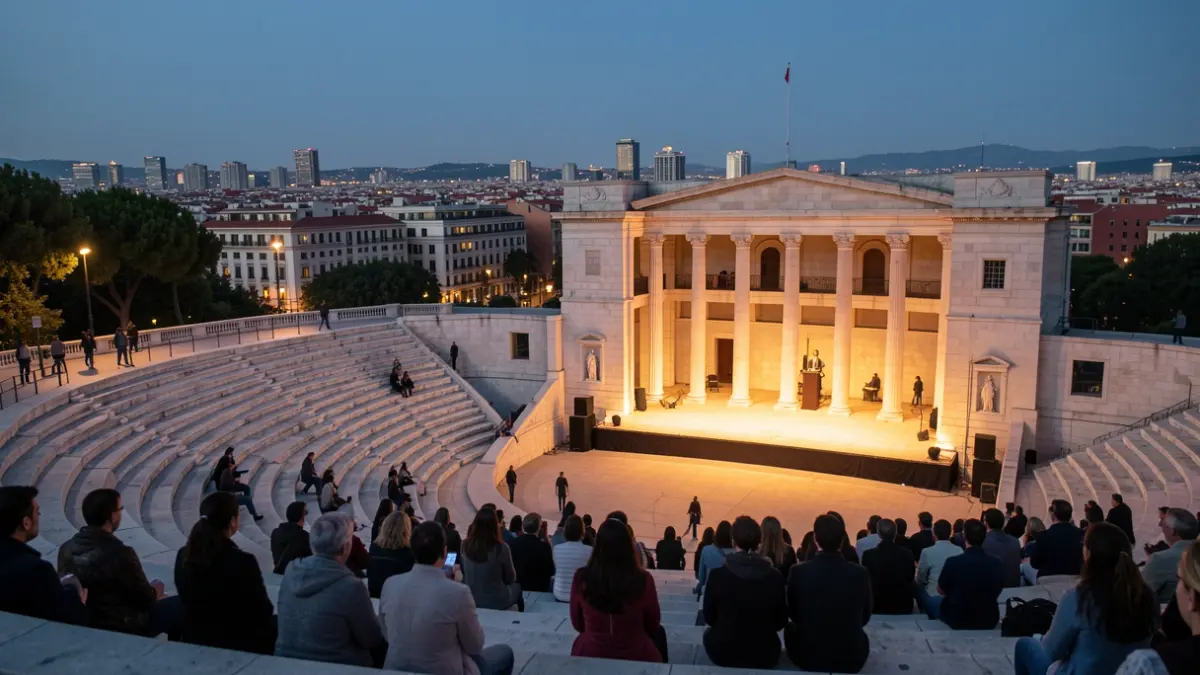
The Festival Grec de Barcelona celebrates its half-century anniversary this year, cementing its position as one of the city's most significant cultural events. Until July 31st, the festival will fill Barcelona with a varied program including theatre, dance, music, circus, and multidisciplinary proposals spread across fifty venues. The heart of the festival returns to the emblematic Teatre Grec de Montjuïc, the amphitheater that lends its name to the summer event, but other cultural venues like the Teatre Lliure, Mercat de les Flors, plaça Margarida Xirgu, and others also actively participate under the "Grec Ciutat" program.
The 50th edition of Grec opened on June 29th with a performance of The Threepenny Opera, by Bertolt Brecht and Kurt Weill, directed by Marta Pazos. This production, co-produced by the Teatre Lliure, also marks its fiftieth anniversary. Among the most anticipated shows are dance pieces such as Inventions by the company Mal Pelo, Theatre of Dreams by Hofesh Shechter Company, and 16 & 17 by the prestigious TAO Dance Theater. In music, highlights include the commemorative concert "Cançons del Grec: 50 anys de música, ponts i mestissatge", as well as performances by Yerai Cortés, Roger Mas with the Cobla Sant Jordi, and Sébastien Tellier. The festival also hosts renowned figures from the international contemporary scene such as Calixto Bieito, Anne Teresa de Keersmaeker, Angélica Liddell, Christiane Jatahy, Mal Pelo, Àlex Rigola, and Hofesh Shechter.
Furthermore, Grec welcomes new international voices like Florentina Holzinger, Ntando Cele, Andrea Peña, Sung Im Her, and the collective Elephants Laugh, expanding the scenic offerings and connecting audiences with diverse sensibilities from the global stage. The Grec 2026 co-productions bring together emerging and established talents, exploring new scenic languages and reinforcing the festival as a key platform for local creation. Artists such as Lorena Nogal, Núria Guiu, Pau Aran, Cultura i Conflicte, and La Perla 29 engage with international creation, projecting Catalan talent abroad.
To commemorate this anniversary, special activities have been organized, including a documentary composed of four short films reviewing the festival's history and a free concert at the Sagrada Família featuring Maria Arnal, Lídia Pujol, and the Cor Cererols. Grec reaffirms its origins from 1976, during the Transition period, and maintains its spirit of transforming Barcelona into a stage open to contemporary creation, international dialogue, and local talent.
The festival's history dates back to 1976, with music as the protagonist of the first event at the Teatre Grec de Montjuïc. The inaugural edition, under the slogan "Per un teatre al servei del poble" (For a theatre at the service of the people), featured concerts by artists like Pau Riba, Iceberg, Maria del Mar Bonet, and La Trinca, and saw slogans such as "Llibertat, amnistia i Estatut d'autonomia" (Freedom, amnesty, and Statute of Autonomy) resonate. Theatre plays like Faixes, turbants i barretines by Xavier Fàbregas and Divinas palabras by the Companyia Núria Espert were also presented.
The Teatre Grec, built in 1929 for the International Exposition, had limited activity until 1936. After decades of inactivity and several reopenings, in 1976 the Assemblea d'Actors i Directors (Assembly of Actors and Directors) took over its self-managed operation, giving rise to the Festival Grec, a benchmark for performing arts in Southern Europe.