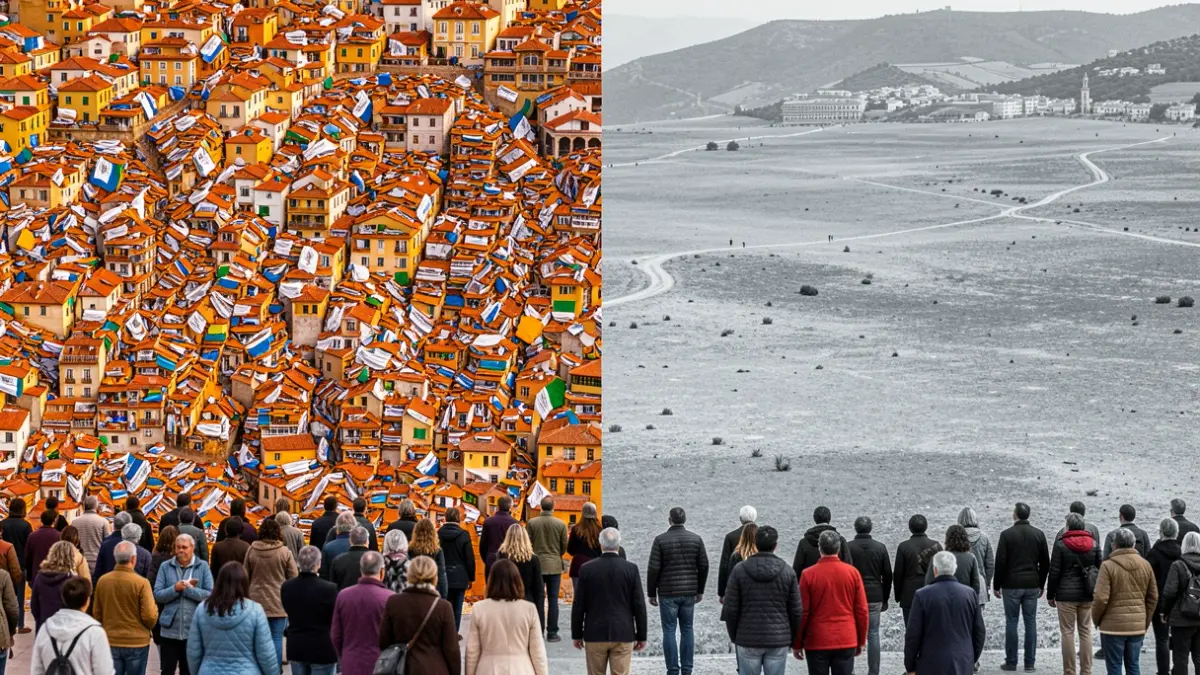
Economic inequality, defined as the uneven distribution of income and resources, has intensified in many Western countries. According to United Nations data, the number of billionaires has doubled since the 2008 financial crisis. The Global Wealth Report 2026 by Boston Consulting Group indicates that wealth is increasingly concentrated in the hands of a small percentage of the population.
In Spain, the gap between rich and poor has become particularly pronounced, according to the laCaixa Foundation. 53% of wealth is held by 10% of the population. In Catalonia, the 2025 Gini Index places inequality at 29.1%, a figure slightly higher than the previous year but lower than in 2015.
Economist Santiago Niño Becerra, a professor at 3cat, describes Catalonia's economy as "very unbalanced." Despite a high total GDP, the GDP per capita reflects widespread impoverishment, exacerbated by low-productivity sectors like tourism, which generate low wages.
The average income in Catalonia is 20,789 euros, but it is primarily concentrated in Barcelona and its metropolitan area, where it exceeds 25,500 euros. As one moves away from this zone, purchasing power decreases: the regions of Girona register between 19,000 and 25,000 euros, while in Lleida and inland Tarragona, the GDP per capita is below 17,500 euros.
Only three regions –Barcelonès, Vallès Occidental, and Baix Llobregat– concentrate 59% of Catalonia's GDP, an extremely high figure compared to other European regions like Germany (46% of GDP concentrated in four main regions). This situation makes a simple solution difficult, as mobility does not resolve the concentration of wealth generation.
Coastal tourist municipalities, despite having an apparently high per capita income, show an individual purchasing power below 20,000 euros. The tourism economy relies on sectors with low wages, part-time hours, and temporary contracts. Real income often goes to large hotel chains or non-resident owners, affecting local taxation.