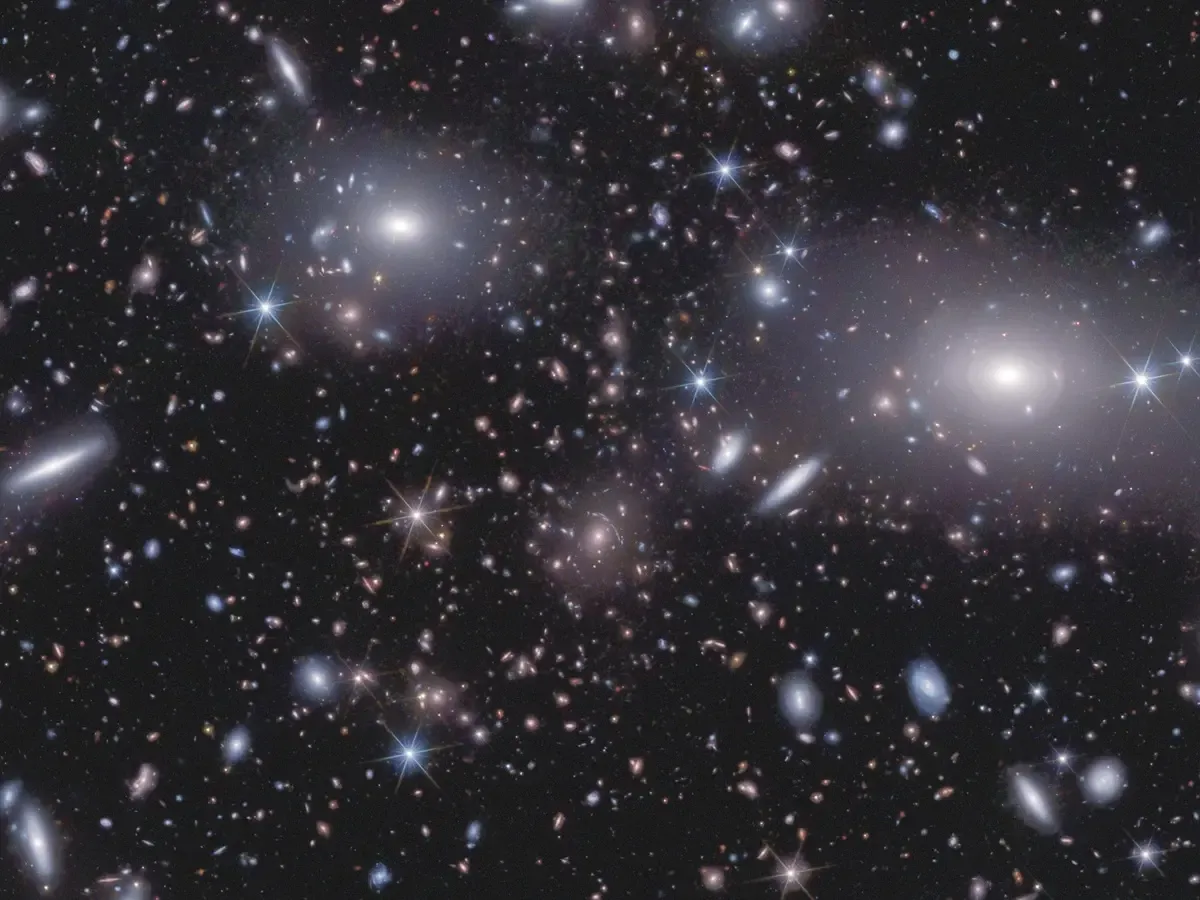
The publication, which includes data from the mission's first year, will enable a wide range of studies about the cosmos. According to Francisco Castander, an IEEC researcher at ICE-CSIC, "the extraordinary quality and magnitude of this dataset will allow for a wide range of studies about the cosmos." This public data will maximize the scientific impact of the mission, facilitating discoveries by researchers worldwide.
DR1-Foundation compiles approximately 13 months of observations and provides the scientific community with the necessary puzzle pieces to begin creating a detailed 3D map of the cosmos, crucial for solving mysteries such as dark energy, dark matter, and the cosmic web. ESA's Director of Science, Carole Mundell, states that "this important Euclid data release represents the largest survey of its kind conducted from space."
The release stands out for its scope, panoramic mosaics, and extensive sky coverage. It contains 1.7 million GB of data, including over 900 million galaxies, nearly 15,000 strong gravitational lens candidates, and over 60 million quasars. This data will establish the foundation for future research into the large-scale structure of the universe.
Euclid can perform deep sky mapping thanks to its position above Earth's atmosphere. The release expands the detection limits for uncommon and distant objects, including the largest catalog of strong lenses compiled to date. Natalie Lines from the University of Portsmouth notes, "More than ten years ago, we predicted that Euclid would revolutionize the field of strong gravitational lens discovery. That day has finally arrived."
The mission, launched in 2023, will image billions of galaxies over six years. Today's release covers only about 14% of the total sky area Euclid will explore. The first full data release, planned for mid-2027, will build upon this and include observations of weak gravitational lenses and calculations on how galaxies integrate into the cosmic web.
The Spanish contribution includes the participation of IEEC, ICE-CSIC, and IFAE in the design and construction of the NISP instrument. The Polytechnic University of Cartagena (UPCT) and the Institute of Astrophysics of the Canary Islands (IAC) were responsible for the control electronics. The Scientific Information Port (PIC) manages cosmological simulations and serves as the scientific data center in Spain.