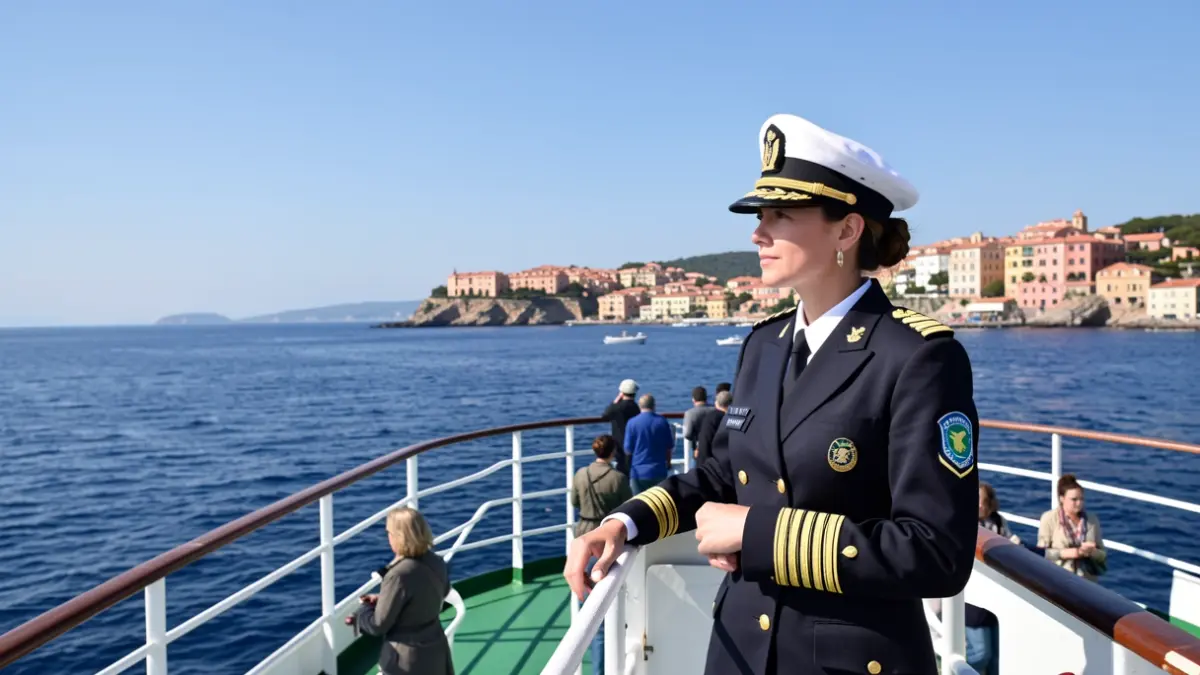
From her childhood in Sitges, Maria Martinez Rami (1988) felt a strong connection to the sea. This passion, combined with a desire to travel, led her to study Maritime Navigation in the Basque Country, a choice that allowed her to see new places before starting her professional career. She began as a third officer on tugboats and tankers, a world marked by male presence, until in 2014 she found an opportunity aboard the Rainbow Warrior III, the ship of the NGO Greenpeace.
Over time, Martinez climbed the ranks within the crew, becoming one of only two female captains among the eight professionals who rotate on the ship. She acknowledges the difficulties of balancing family life, with two young children, in a predominantly male sector with demanding schedules, especially when a partner also works in the same field. Although she doesn't rule out a future away from the sea, she is currently satisfied with her contribution to Greenpeace's projects.
Her environmental vocation dates back to her teenage years. "I didn't want a job that went against my values, but one that added to them," she explains. Joining Greenpeace represented for her the alignment of her profession with her commitment to the planet. Aboard the Rainbow Warrior, the crew undertakes various tasks, such as scientific research to analyze the presence of plastics in water and fish, or documenting activities like deep-sea mining in the Pacific, advocating that these resources belong to everyone and must be cared for.
As captain, Martinez holds ultimate responsibility for the ship and its crew. "I am ultimately responsible for everything that happens on the ship," she states. Her authority extends to making decisions about the actions the NGO undertakes. "If they propose an attractive action, I am the first to decide, 'let's do it,'" she notes. This leadership capacity is crucial, especially in missions like the recent one in South Africa and Namibia, where they intercepted a ship destined for oil exploration, aiming to halt the Rosebank project.
Martinez also addresses the reality of piracy in international waters, particularly in areas like near Nigeria, the Congo, or the Suez Canal. Although she hasn't experienced it directly, she admits to having been in tense situations. "I also understand it, because Western countries with power take all their resources, and no one goes to war because they want to; it's a matter of survival," she reflects on the causes of this issue.