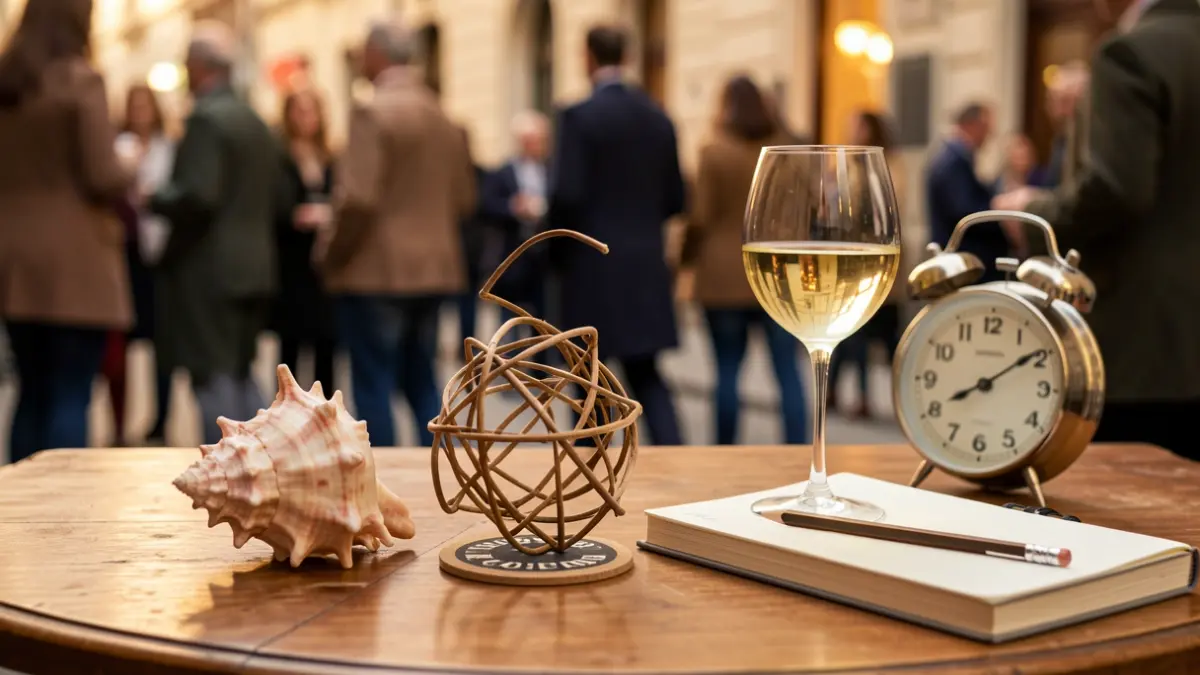
The artistic work 'Pareidolia' by artist Olga Delgado invites us to explore the complex relationship between perception, memory, and artistic creation. In a detailed still life, Delgado gathers objects with strong personal value: a seashell, a sculpture made of twigs with flamenco resonances, a glass of white wine on a coaster from the iconic Jamboree jazz club in Barcelona, a notebook with a pencil and a book, and an alarm clock turned face down against the wall.
This first oil painting by the artist, titled Self-Portrait, uses the alarm clock as a visual metaphor. Its rear part, with the winding keys and inverted arc, transforms into an afflicted human physiognomy, evoking existential finitude and a discouraged mood.
The concept of pareidolia, defined as the psychological phenomenon of recognizing familiar shapes, especially faces, in random patterns, is central to the reflection. This tendency, which organizes perception into meaningful patterns associated with memories and emotions, formed the basis of the Rorschach test, although its current scientific validity is questioned.
Following the ideas of Leonardo da Vinci in his Treatise on Painting, Delgado suggests that contemplating ambiguous forms, such as those on a stained wall or in clouds, can be a powerful stimulus for imagination and artistic creation, allowing the painter to visualize landscapes, battles, or human figures.
The reflection extends to the imaginative capacity of blind individuals, who often develop extraordinary imagination, in contrast to those who suffer from aphantasia. To look, therefore, is not merely to register the world, but to imbue it with form, meaning, and affect, recreating and interpreting reality through perception and memory.