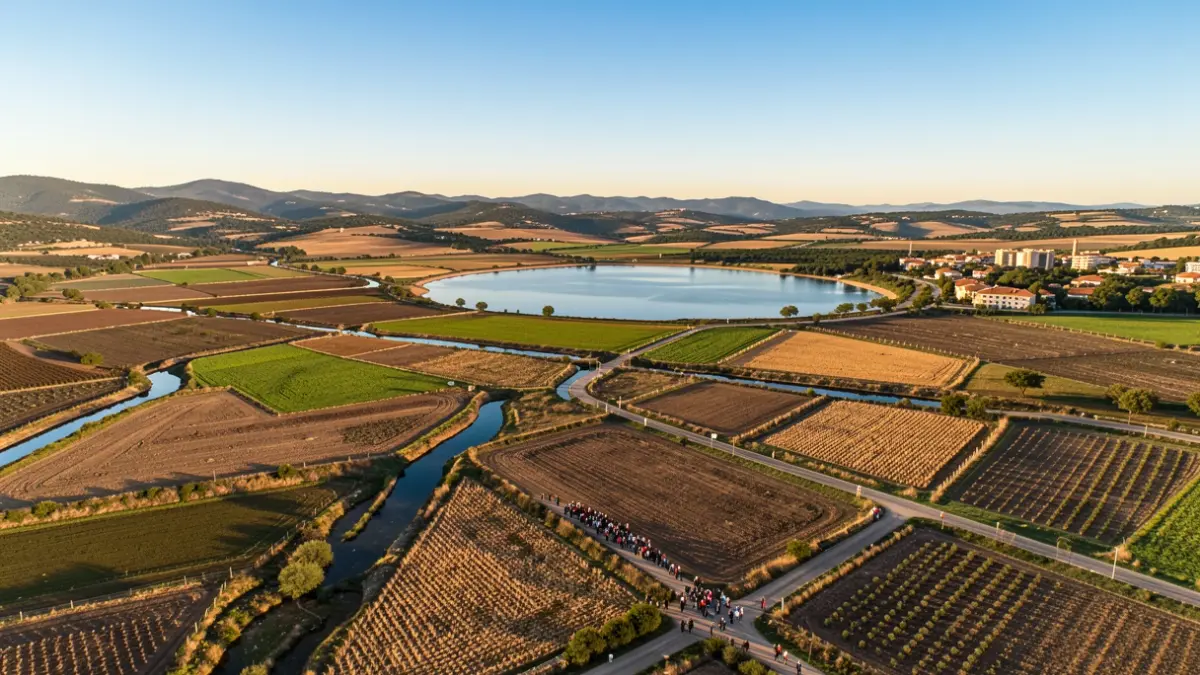
This investment will serve 935 agricultural holdings in the municipalities of El Cogul, Granyena de les Garrigues, Aspa, L'Albagés, El Soleràs, Juncosa, and La Granadella. With this expansion, the total area committed to the canal's irrigation will reach 26,000 hectares, approximately 40% of its current irrigable capacity.
Xavier Gispert, Director General of Irrigation and Agricultural Areas, explained that while the projects cover an irrigable area exceeding 3,000 hectares, the surface to be activated in this phase will be 2,100 hectares, corresponding to landowners who have already formalized their adhesion to the system.
Gispert recalled that the Generalitat has already invested over 100 million euros in this canal. The new actions are part of the 2025-2040 Irrigation Strategy, which plans an investment exceeding 3 billion euros to modernize 181,000 hectares across Catalunya. The goal is to promote more efficient irrigation to adapt to climate change and enhance farm profitability.
According to Gispert, the irrigation improvements are helping to reverse the demographic and economic decline in Les Garrigues, encouraging population settlement and economic development in the region.
Meanwhile, Enric Ortega, Director General of Aigües Segarra-Garrigues (ASG), indicated that the works are expected to be operational for next year's campaign. He highlighted that the project includes a new pumping station designed to minimize energy consumption, a crucial aspect given the significant electricity costs for the canal's operation.
Ortega also announced the development of an artificial intelligence tool to optimize irrigation for each plot, using mathematical models and satellite data to save water and energy.
Josep Maria Jové, President of the General Community of Irrigators of the Segarra-Garrigues Canal, explained that works commence when at least 60% of the planned area has formalized its adhesion agreement. Each farmer contributes 3,100 euros per hectare, plus approximately 4,000 euros for on-farm irrigation system installation.
Jové emphasized irrigation as a key strategy for the future of the drylands of Ponent and for retaining population in the area. He noted that the l'Albagés reservoir currently holds 56 cubic hectometers of its 83 cubic hectometer capacity, with the Ministry committed to maintaining this volume.