Catalunya is preparing to experience a total solar eclipse on August 12, an exceptional astronomical phenomenon not seen since 1905 and not to be repeated until November 17, 2180. The event will take place between 7:30 PM and 9:00 PM, depending on the location. The southern third of Catalunya will enjoy a complete view, while the rest of the territory will be able to observe it partially.
In the province of Girona, the eclipse will be partial but very significant, reaching 99% occultation. For better observation, it is recommended to seek out viewpoints, open fields, elevated terraces, or spaces with a clear western horizon free of mountains, trees, or buildings. Locations such as the Santuari dels Àngels near Girona, Sant Pere de Rodes in Empordà, and Palafrugell are highlighted for their visibility. Conversely, more enclosed areas like some valleys in Garrotxa and Ripollès might present difficulties.
It is essential to use certified eclipse glasses throughout the observation, as there will be no totality phase in Girona that allows direct viewing of the Sun. The Ministry of Science has launched the website trioeclipses.es, which offers an interactive viewer to determine the eclipse's visibility from the user's exact location by activating the mobile camera.
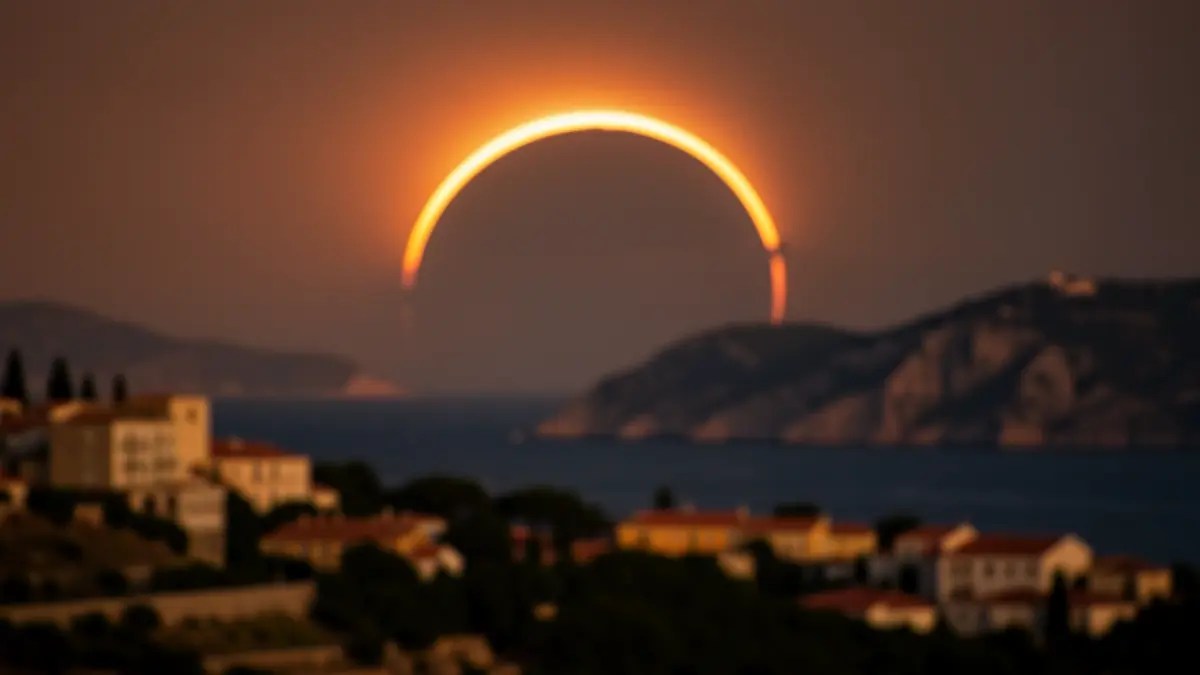
The eclipse will begin at 7:34 PM with the Moon passing between the Earth and the Sun. In Girona, the maximum point will be reached at 8:28 PM, with 98.97% solar occultation, leaving only a thin sliver of light visible. In Blanes and Lloret de Mar, the occultation will be slightly higher. Despite a significant decrease in ambient light, complete darkness will not be achieved.
Around 8:53 PM, the Sun will set while still partially eclipsed. In Girona, sunset will coincide with the end of the phenomenon, with a thin solar crescent descending towards the horizon.
The Albanyà Astronomical Observatory has organized activities for all ages, which are fully booked. Although only about 35-40 minutes of the eclipse will be visible in Albanyà, live images from the Ebro Delta will be projected. Activities include talks, rocket-building workshops, and observation of the Perseid meteor shower.
The Girona Astronomical Association will also host a viewing event from the Llagostera observatory, distributing glasses and explaining the phenomenon. It is advised to avoid using cars for travel to observation sites due to anticipated traffic congestion.
In the Camp de Tarragona, Terres de l'Ebre, and southern Ponent, the eclipse will be total. The Government has designated 23 official safe observation points in 18 municipalities, featuring ample space and services. 150,000 certified glasses will be distributed for free, and Mossos d'Esquadra will deploy 700 officers. Avoiding the AP-7 highway is recommended.
The eclipse has already generated a significant tourism impact, with an increase in bookings at accommodations and restaurants, particularly in inland areas. In Lleida, hotel occupancy exceeds 90%, and the Paeria expects 10,000 visitors.
In Spain, after this eclipse, another total solar eclipse visible in Catalunya will not occur until 2180. Although total solar eclipses happen globally twice a year, visibility from a specific location is rare. On August 2, 2027, another eclipse will be visible in southern Andalusia, Ceuta, Melilla, and parts of Cádiz, Málaga, Granada, and Almería.
On January 26, 2028, an annular eclipse will occur, where the Moon will not completely cover the Sun, forming a "ring of fire." This phenomenon will be primarily visible from Tarragona, Lleida, and Barcelona, coinciding with sunset.