
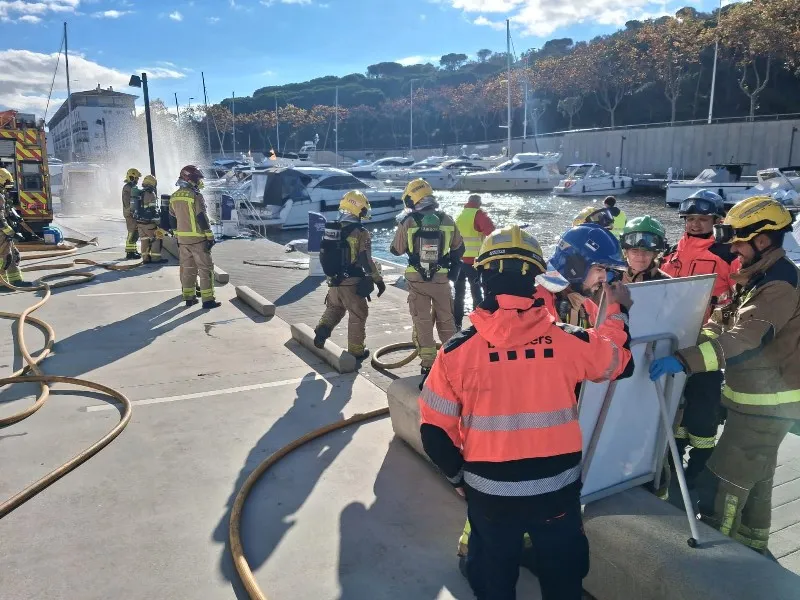
The exercise, which started at 10.30 hours, simulated a fire on a moored vessel in the harbour with a fuel spill at sea. The medium-severity contamination scenario, in which the means available at the installation could be insufficient or the threatened area could be vulnerable, allowed for the assessment of the activation of the CAMCAT plan in the alert phase.
Staff at the Port d'Aro Yacht Club tested the procedures set out in their PAU, with the mobilisation of internal intervention, evacuation and confinement teams, under the coordination of the harbour master, who acted as emergency commander. Procedures for alerting the emergency telephone number 112 and the Catalonia Operational Coordination Centre (CECAT were also practised.
One of the highlights of the drill was the reception of external emergency services and their escort to the scene of the incident, given the layout of the harbour facilities. The Catalonia Fire and Rescue Service participated with five crews from the Vall d'Aro and Palafrugell parks, a command post and the joint Fire and SEM team.
In a scenario simulating a fire on a vessel with a fuel leak, access manoeuvres to the fire zone and workspace management were practised in a very narrow space to avoid operational collapse. According to the established action plan, the priority was to prevent the fire from spreading to other vessels. To achieve this, vessels located in the vicinity of the damaged vessel were moved.
In a second phase of the intervention, the fuel spilled on the water surface was controlled by placing harbour containment booms, carried out by the harbour crew, and applying a foam blanket, with the aim of preventing possible reignition of the fuel. Throughout the exercise, coordinated work was carried out with the harbour crew, one of the main objectives of these drills in sports marinas and yacht harbours.
The Mossos d'Esquadra (Catalan police force) participated in the drill with two crews from the Citizen Security Unit (USC) of Sant Feliu de Guíxols and a Maritime Police unit from Palafrugell. The exercise allowed the procedures set out in the Port d'Aro Yacht Club Autoprotection Plan to be practised and coordination with external emergency services to be tested, with the aim of improving the response to emergencies at the harbour facilities.
The Local Police of Castell d'Aro, Platja d'Aro and s'Agaró participated in the drill integrated into the order group, in coordination with the rest of the emergency bodies. The exercise also allowed procedures for receiving external aid resources to be worked on. MAR-SAL (Spanish Maritime Rescue and Safety Service) participated in the drill with the Salvamar Sirius vessel, supporting the emergency teams that intervened at the harbour facilities and in accordance with the coordination procedures established for emergencies within the harbour.
Civil Protection of the Generalitat participated in the organisation and coordination of the drill, designed to test alert and response procedures in the event of a harbour emergency and to assess the activation of the CAMCAT plan. The Catalonia Operational Coordination Centre (CECAT) received the communications of the start and end of the simulated emergency and recorded the incidents of the exercise for subsequent evaluation. The drill also included an observer from Civil Protection of the Generalitat and two observers from the Baix Empordà County Council to monitor the exercise and participate in the assessment of the operating procedures.