The Catalan Waste Agency, part of the Department of Territory, Housing and Ecological Transition of the Generalitat de Catalunya, has published the results on the generation, selective collection, and recycling of municipal waste in Catalonia for 2025. Total municipal waste generation stood at 3.92 million tons, an increase of 1.8% from 2024. This equates to 483 kg per inhabitant, slightly higher than the 481 kg per inhabitant of the previous year.
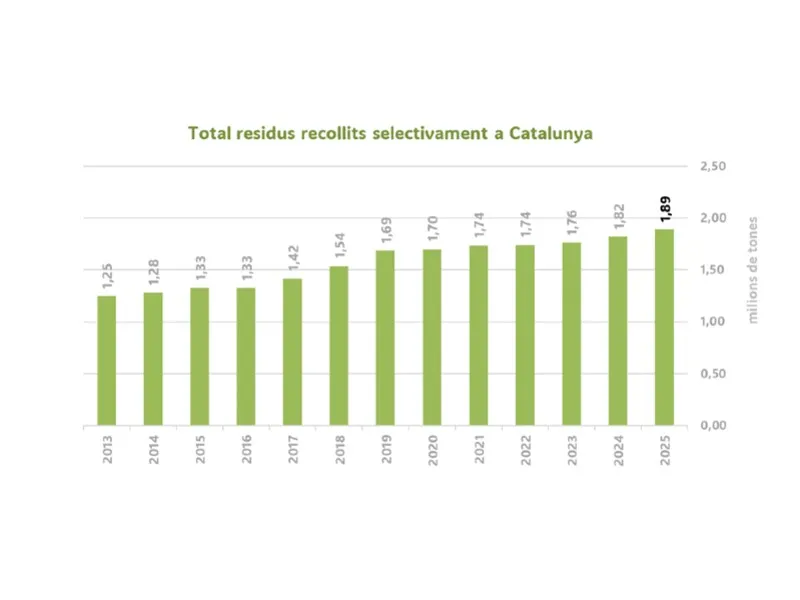
Of this generated waste, nearly 1.6 million tons (41%) were sent for recycling. Selective collection at source reached 48.1% of the total (1.89 million tons), a figure higher than the previous year (1.82 million tons, 47.3%). However, the percentage sent to recycling companies is below the European target of 55% set for 2025.
The residual waste fraction, which accounts for almost half of the municipal waste generated (52% of the total, 2.03 million tons), remains a challenge. Although the per capita generation of this fraction is decreasing to 250 kg per inhabitant, its reduction is key to meeting environmental objectives. 72% of the residual waste fraction received pre-treatment before landfilling or energy recovery, while 18% went directly to landfill and 10% to energy recovery.
The data also indicate a slight improvement in the relationship between waste generation and GDP, suggesting some decoupling between economic growth and municipal waste production, although no significant structural change is observed.