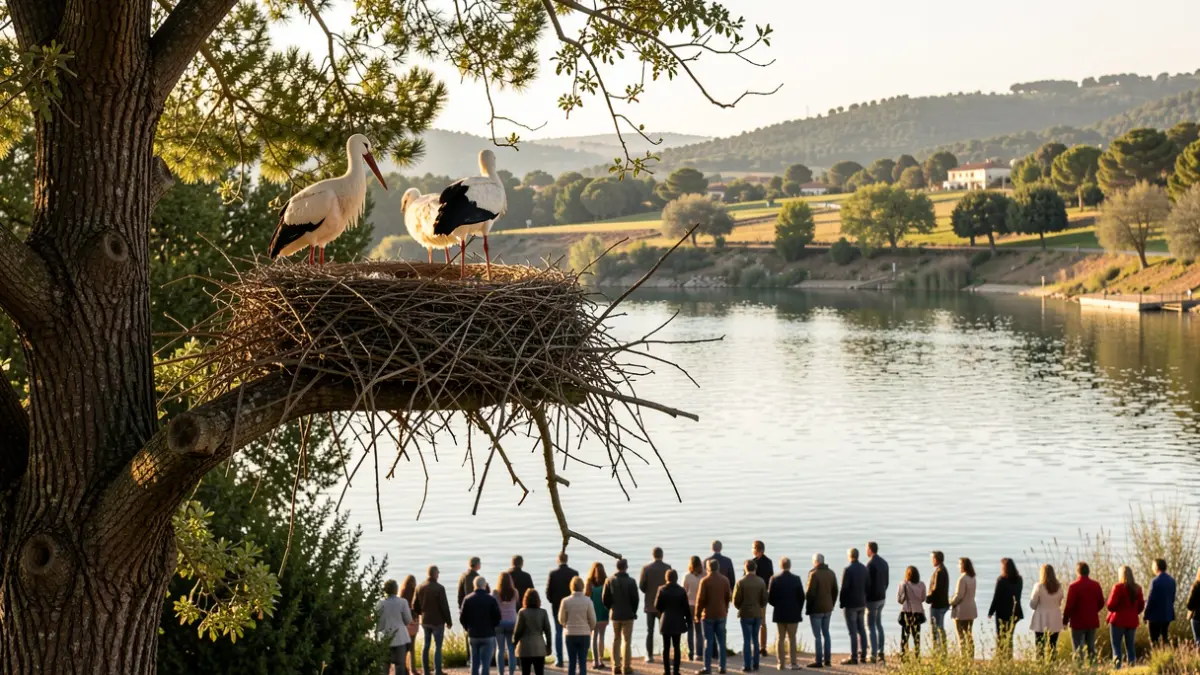
The population of white storks (Ciconia ciconia) at the Estany de Banyoles has reached a historic milestone this breeding season. A total of 19 chicks have been recorded surviving to flying age, an unprecedented figure since censuses began in 2006. This success solidifies the natural area as a vital refuge for the species in the Pla de l'Estany region.
The 9 breeding pairs counted last year have been maintained. The colony of 7 nests at the Vilar pond remains, despite the replacement of two fallen nests. Another pair has relocated to a poplar tree in the ca n'Ordis pond, demonstrating the birds' adaptability. These censuses, conducted by the Consorci de l'Estany, confirm a stable and well-established population, with individuals frequently seen in cultivated fields and wetlands of the region.
The season has been described as historic not only for the number of surviving chicks (19) but also for the overall survival of the brood. These figures significantly surpass the 10 chicks from 2025 and the 6 recorded in 2019 and 2024. A curious event was the change of location for a pair that was nesting in the Casa Nostra lagoon, which eventually settled in a poplar tree in the Vilar stream, successfully raising 2 chicks.
Despite the positive news, the Consorci de l'Estany expresses concern about the falling trees in the Vilar pond area and other parts of the Estany, as this reduces the availability of nesting sites for storks.
The reintroduction project, initiated in July 2006 in collaboration with the Fundació Catalunya la Pedrera, has been a notable success. Following the release of 11 ringed individuals in 2008, the species' presence has progressively consolidated.
“"We are facing a protected fauna reintroduction project that has been a great success due to the work done by both the administrations and the Consorci technicians. Beyond land restoration, it has also been a project that has contributed to awareness, environmental education, and the promotion of the Estany de Banyoles lake basin."
In addition to the resident population, the migratory passage of storks through the Pla de l'Estany between August 1st and September 15th is increasingly spectacular each year. This summer, approximately 1,500 individuals were detected in transit, some of which spent the night in the city of Banyoles or in the Terri valley. These migratory birds gather in large flocks in the morning to continue their journey south, utilizing thermal currents. Some stop to feed at the landfill or in the wetlands around Estany de Banyoles.