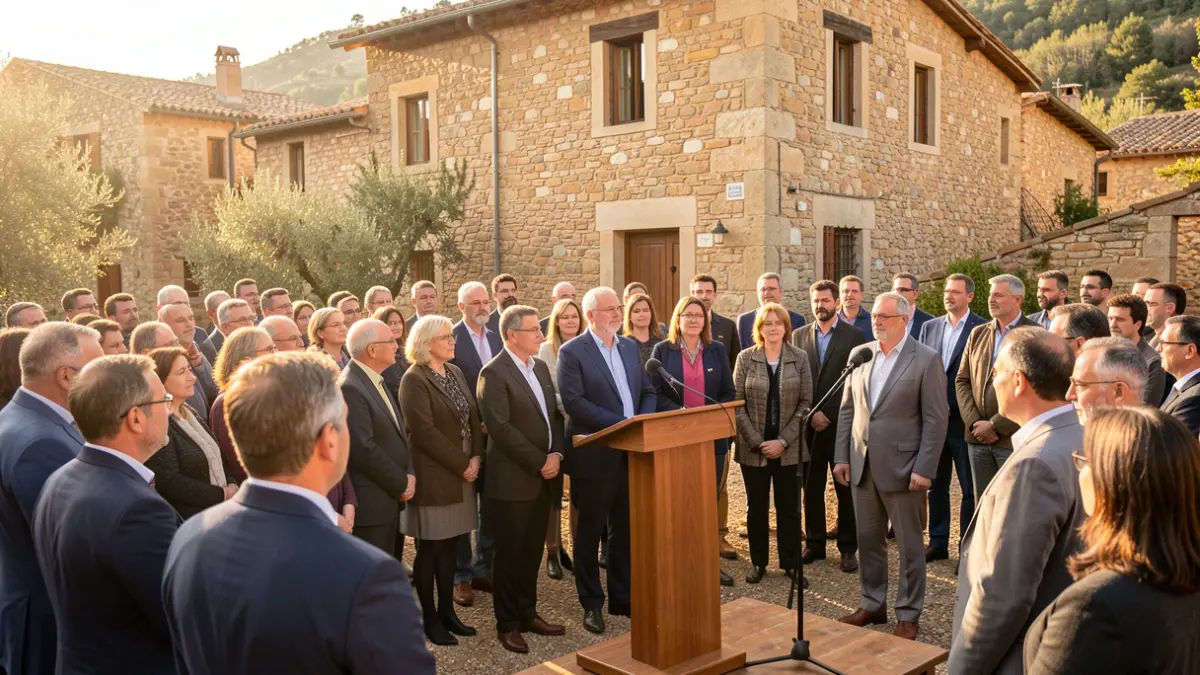
Former mayor of La Seu and ex-MP Albert Batalla described the event as an "act of justice". The ceremony, held in Planoles under the auspices of the JNC, brought together leaders from Junts and prominent figures from the former CDC. Due to his age, Pujol's speech was read by the president of the JNC's national council, Carlota Monfort, and was framed as a political legacy for Catalanism.
The speech, theoretically aimed at young people but with broad reach, emphasized the idea of Catalonia as a "will to be" and urged the country to remain an "integrative" place, capable of welcoming and uniting people arriving from elsewhere. Pujol warned against "extremist tendencies" and stressed that Catalonia "is worth it" despite challenges.
“"Catalonia has been made by its people."
At 96 years old, Pujol argued that a nation's strength lies in the robustness of its society, not solely in politics. He cautioned that "no government can save it" if a society loses its sense of responsibility, its culture of effort, or its self-confidence. "National construction," he argued, transcends institutions and requires fostering national consciousness.
He urged overcoming "fear," "pessimism," and "nostalgia," and strengthening the idea that a "small nation only survives if it has personality." Catalonia's history, he noted, is a "history of persistence, resistance, reconstruction," and he encouraged young people to prepare themselves without relying on "slogans" or "social media."
“"Catalonia is above all a will."
Defining Catalonia as a "collective will to be" and a "renewed decision generation after generation not to disappear," Pujol called for combating "internal weariness" and "resignation." He emphasized that Catalonia's language, culture, collective identity, and freedom "continue to be worthwhile."
He listed the "duties" of Catalans, such as "maintaining the language, transmitting culture, integrating those who come from outside, and cohesion." He underscored the duty to "work well, to serve, not to give up," and to "serve Catalonia without expecting anything in return," setting "service" and "contribution to the common good" as the goal.
Pujol highlighted the integrative capacity of Catalan society, describing it as "plural, diverse, complex," and stated that its strength lies in "the ability to integrate, to add, to make very different people feel involved," a "great historical victory" that must be preserved.
“"Catalonia is an unfinished work."
In the final part, he admitted "successes and errors" but reiterated that "Catalonia is worth it." He warned that "Catalonia is an unfinished work" and that each generation is merely its "custodian," receiving, caring for, enriching, and transmitting it. He urged new generations to continue this task with "intelligence, courage, a sense of responsibility, with love for the country and with hope."
He concluded by "entrusting a mission" to Catalanism: "Love Catalonia, serve it, defend it, make it better, leave it stronger for those who come after." He expressed confidence that a Catalonia "more cultured, more just, more cohesive, more self-aware" would make "everything worthwhile."