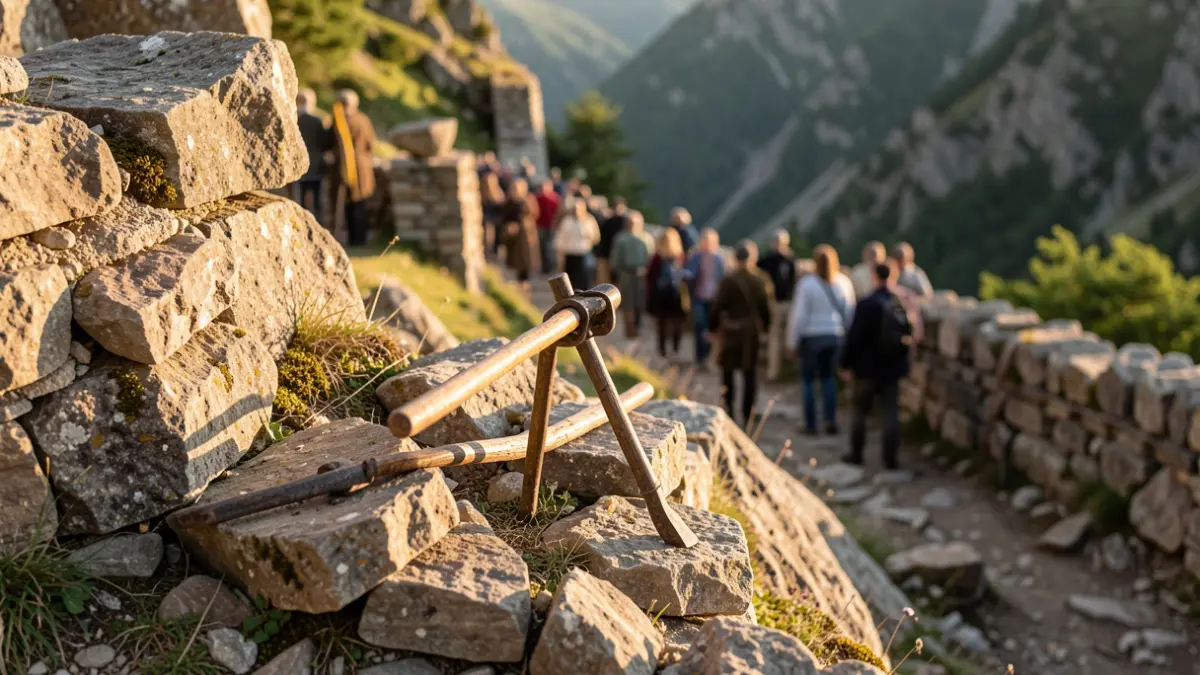
The actions focused on two main areas. At Mola de Genessies, a site located at height in the municipality of Vandellòs, the team carried out vegetation clearance and photogrammetric surveying to detail the preserved structures. Surface prospecting recovered materials pointing to two differentiated occupation phases: one of prehistoric chronology and another of late Roman era. Two small trenches were also opened to study stratigraphy and date the structures, confirming the archaeological potential of the site for future campaigns.
Parallel to this, during November, the team continued research in the Ports of Tortosa, with actions in the municipalities of Tortosa, Roquetes, Paüls and Alfara de Carles. Seven caves, four water points and five areas with archaeological potential were prospected. Among the most outstanding results is the location of a new prehistoric site in a cave in Roquetes, as well as two sites with evidence of Roman and medieval occupation in Tortosa and Alfara de Carles. All three are located at over 1,000 metres above sea level, providing new data on human occupation dynamics in mountain areas.
The results obtained from these prospecting campaigns constitute the basis for planning excavation campaigns to be carried out next year. The data recovered open new lines of research to deepen understanding of chronologies, occupation forms and population dynamics in the southern prelitoral mountain range. The project, directed by doctors Jordi López (ICAC) and Josep Maria Vergès (IPHES), is funded with the support of the Government of Catalonia.