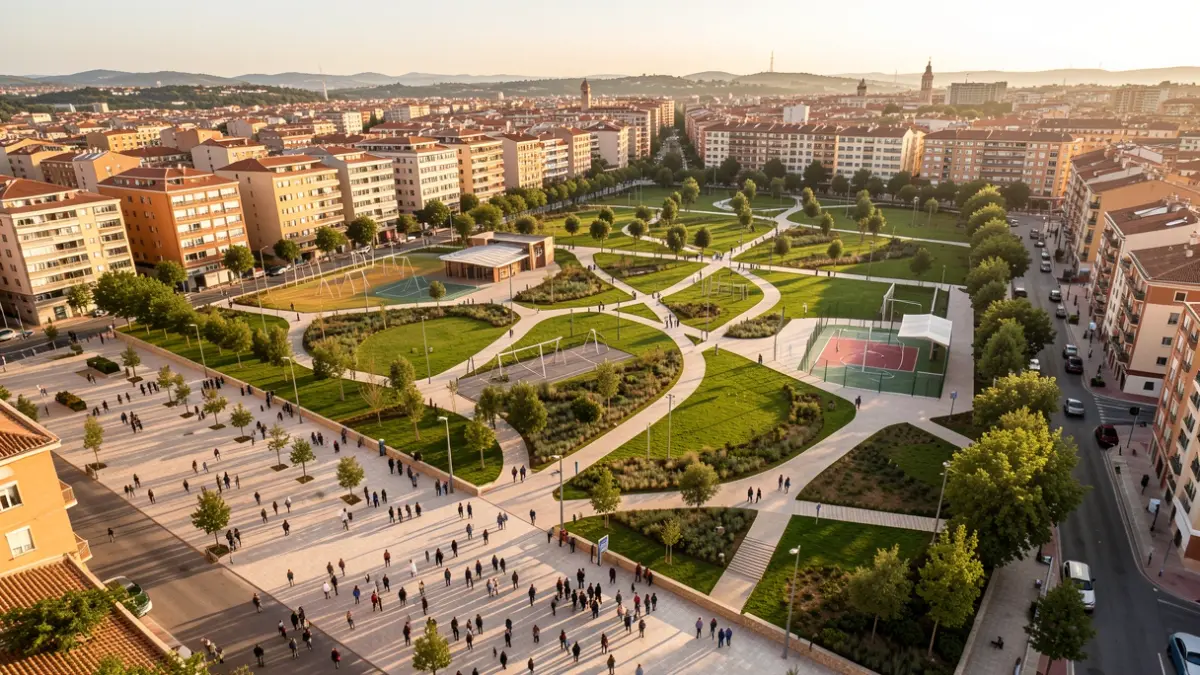
The Republic Park, located in the Sant Pere Nord neighborhood, one of Terrassa's most densely populated areas, will become the city's second-largest green space. Spanning 35,000 square meters, its completion is scheduled for autumn, aiming to create a new hub in the city's northeast. The park will integrate leisure, culture, and sports areas, coexisting with existing and new civic and socio-health facilities, while respecting its historical identity.
Historically, the Sant Pere Nord area was a landscape of vineyards, olive groves, and almond trees until the early 20th century. The Pla de les Arenes was crossed by paths such as Can Petit and Santa Magdalena de Puig Barral, where around 1910 the first shacks were built by immigrants, mainly from Andalusia, forming a small inhabited nucleus. Over time, this area has become Terrassa's third most populous neighborhood, with approximately 16,000 inhabitants.
The new park, situated between Béjar and del Vallès avenues, Francesc Macià boulevard, and Provença street, is described as a green lung covering 23,000 square meters. It will be the city's second largest, after Vallparadís Park, and will offer diverse uses such as a climate refuge, sports area, cultural, educational, and health facilities, as well as children's play areas.
The project, with an approximate cost of five million euros, has involved citizen participation to become an intergenerational meeting point. The initiative, which began development in 2017, includes a northern sports island with a court, football field, and petanque area, and anticipates a future CAP Terrassa Nord health center at the corner of Béjar and Provença.
In the southern section, the Francesc Macià civic center and the district 6 library have been expanded with a new 200 m² space for the Esplai La Guspira. The park also features a new outdoor amphitheater and paths connecting the different areas, reclaiming the routes of old paths like Mina or Cal Petit, and overcoming a twelve-meter elevation difference.
The children's play areas include wooden structures, giant slides, a large trampoline, and an eight-meter tower, with inclusive elements for children with reduced mobility. There are also ping-pong tables, basketball hoops, and calisthenics equipment.
The park's vegetation comprises nearly 455 fruit trees, Mediterranean forest trees, and riparian trees, with the replanting of olive trees from the Can Parellada water deposit. Additionally, a large rectangular basin will collect irrigation and rainwater to supply the natural space.