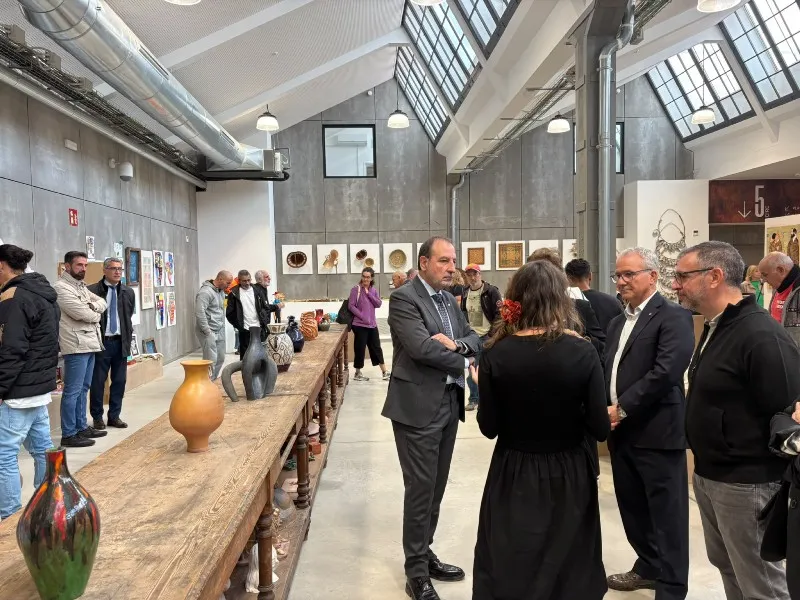
More than 50 professionals lead around fifty artistic workshops in Catalan correctional facilities, with an annual participation of nearly 3,000 inmates. This pioneering initiative was commemorated at the Tèxtil Rase - Fàbrica de Cultura space in Cardedeu, attended by Minister Ramon Espadaler, Secretary of Penal Measures and Reintegration, Elena Pérez, and Director General of Penitentiary Affairs, Domingo Estepa.
The commemorative exhibition L’ametlla amarganta (The Bitter Almond), which spans four decades of artistic creation in Catalan prisons, has opened in Cardedeu and will be on display until November 15th. The title evokes the contrasts of prison life and the possibility of expression through art.
Minister Espadaler highlighted that art workshops are a tool for liberation and a fundamental part of the Catalan penitentiary model, enabling inmates to live more fully and pursue artistic creation. He thanked the professionals and the collaboration of artists and cultural institutions such as MACBA, CCCB, and the Teatre Nacional de Catalunya.
The event also included the presentation of a trailer for a documentary on the 40 years of art workshops and the new commemorative website (artisticspresons.cat). Awards were presented from the Assumpció Moncunill Painting Competition and the Mas d’Enric Penitentiary Center Photography Competition.
The workshops, encompassing disciplines such as painting, drawing, sculpture, ceramics, photography, theater, and music, foster creativity, autonomy, and the development of personal and social skills, connecting artistic creation within correctional facilities with the broader cultural life.