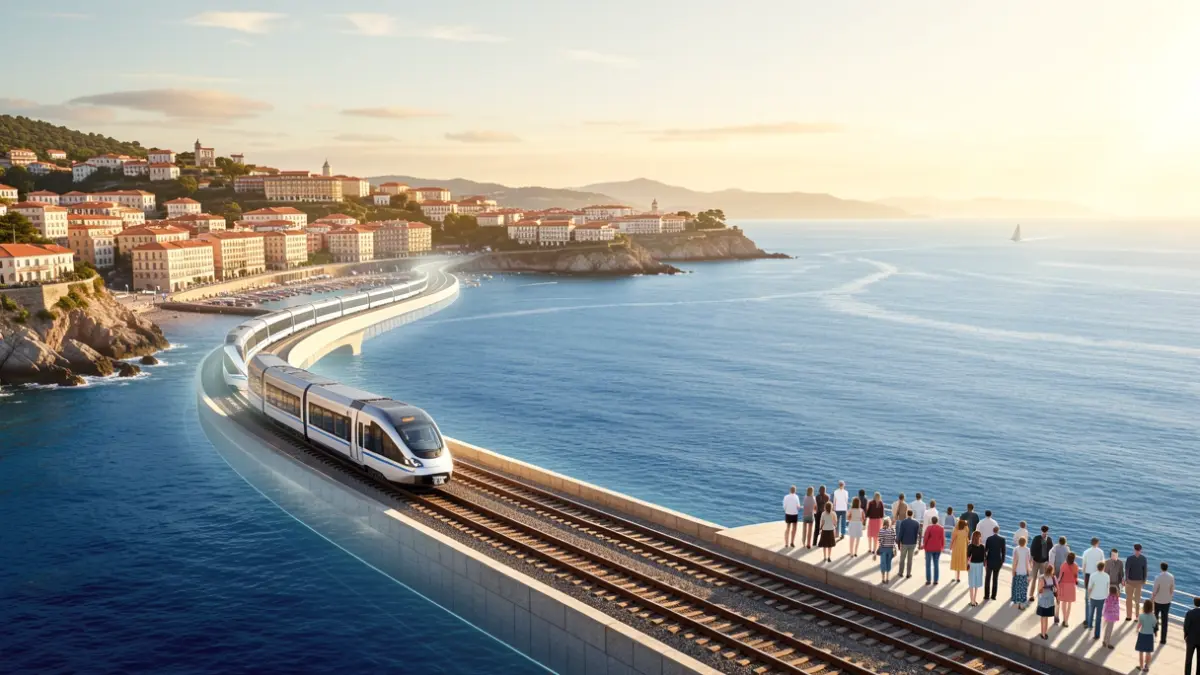
The agreement, sealed in Sant Sadurní d’Anoia, marks the end of a long period of investment deficit in Catalan railway infrastructure, according to Illa, who described the new line as a "commitment to the country" to enhance "competitiveness" and offer attractive journey times.
The project is unveiled at a crucial time for the Generalitat's budget negotiations. Junqueras championed the initiative as "more than just a train line," linking it to a change in the country's model and improvements in housing, education, and health access, while avoiding direct association with the budget agreement.
The head of the Catalan executive thanked ERC for their "sense of country" and "political courage," framing the orbital train's creation within a broader pact to be released "in the coming days," without explicitly mentioning the budget.
The orbital train's deployment will occur in several phases. The first, scheduled for 2034, will connect Granollers and Terrassa with 32 new kilometers, including the section between Santa Perpètua-Barberà and Sabadell Nord, with fifteen stations (five new). This phase also involves doubling the R3 line and quadrupling the R8 line in key sections.
The second phase, for 2037, will link Mataró and Granollers with 23 kilometers of tracks and six new stations. The third phase, expected to be completed in 2040, will connect Terrassa and Vilafranca del Penedès with a new track section and six stations. Finally, the fourth and last phase, concluded in 2041, will construct 29 kilometers of tracks and six stations to link Vilafranca del Penedès and Vilanova i la Geltrú.