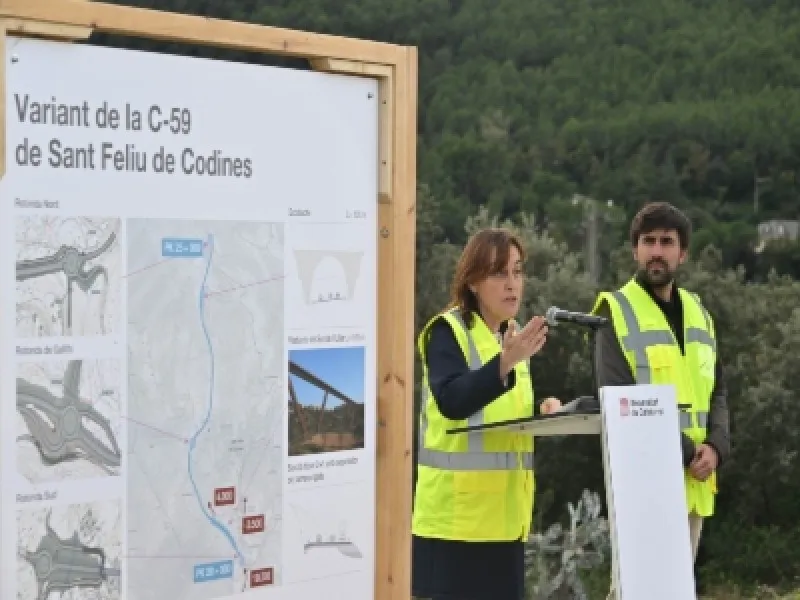
The new road, which will be over four kilometers long, will allow the removal of approximately 3,500 daily vehicles from the urban center, enhancing commercial activity, reducing pollution, and creating a higher quality urban ecosystem for pedestrians. The Minister of Territory, Housing, and Ecological Transition, who visited the start of the works, highlighted that this action responds to a "long territorial demand" and will enable the municipality's urban development and integration.
The variant is part of Catalonia's mobility plan, focusing on sustainability, urban regeneration, economic activity, road safety, and public transport stimulation, all contributing to decarbonization. The minister stated that the project "exemplifies the vision of conceiving the country according to the growth and progress we want for our municipalities" and the need for "mobility architecture that adapts to this new dimension" of Catalonia.
The infrastructure will run along the west of the urban center and will feature a third lane in the direction of Moià for 3 kilometers of its route to facilitate overtaking, while sections with less slope will have one lane per direction. Notable elements include a 515-meter viaduct to cross the Ullar ravine and a 120-meter false tunnel at Can Bosc, which will serve as a wildlife crossing and ecological connector.
To ensure safety, the variant will include a flow separator between the two directions of traffic, with a concrete barrier in sections with a third lane and acoustic and reflective elements in two-lane sections. The project also includes the construction of three roundabouts to connect the new road with the existing network, including a new access to Sant Feliu de Codines.
This action is in addition to other improvements on the C-59, a key route connecting several regions. Concurrently, the Department and the Sant Feliu de Codines City Council are working on an agreement to improve and integrate the current crossing once the variant is operational.