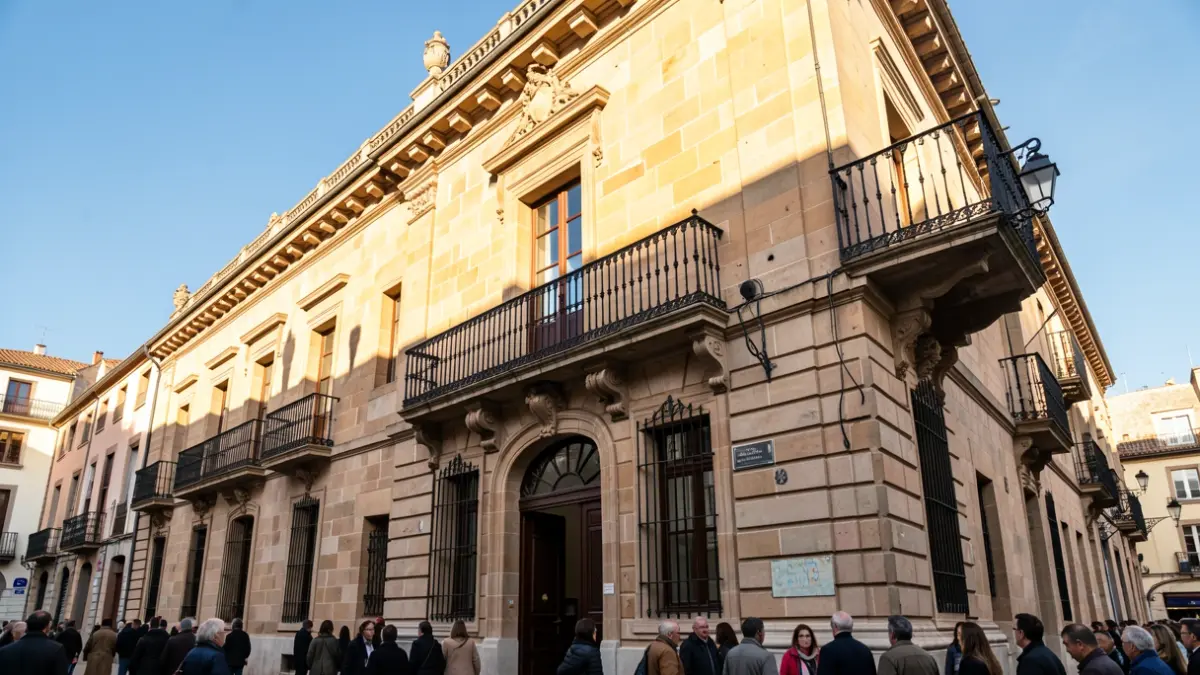
The city of Figueres has remembered the figure of Salvador Fàbrega i Llauradó, born in 1910, recognizing his unique role during World War II. The tribute focused on his birthplace, located at the corner of Peralada street and Germanes Massanet street, where family descendants from Barcelona and Figueres attended the unveiling of a commemorative plaque.
The event, led by the deputy mayor and councilor for Historical Memory, Josep Maria Bernils Vozmediano, highlighted the public recognition of a figure who for decades was practically unknown in his hometown. After the plaque unveiling, also attended by councilor Xavier Amiel, the tribute continued at the Museu de l’Empordà with a lecture by historian Ramon Freixes, a key figure in recovering his life story.
The research by Ramon Freixes, published in Sàpiens magazine, has been fundamental in bringing Salvador Fàbrega's biography out of obscurity, documenting his fight against fascism in Europe and his subsequent collaboration with the Allies. Today's tribute also celebrates this historical research that has returned Fàbrega to his rightful place in the city's collective memory.
Salvador Fàbrega, born in Figueres on June 1, 1910, was a multilingual and adventurous man. His childhood between the Vallespir and the Empordà allowed him to master Catalan, Spanish, and French. Later, he learned German while living in Germany, a skill that would be crucial in his military career. He also acquired knowledge of English and Arabic.
During the Civil War, he fought on the Republican side, participating in the Battle of the Ebro as a lieutenant. After the Republican defeat, he experienced exile in the Argelès camp. Later, he joined the US Army, participating in high-risk missions in northern Italy between 1944 and 1945, infiltrated behind Nazi lines and in contact with partisans.
Captured in March 1945 by the SS, he endured interrogations and torture without revealing information. He played a prominent role in the liberation of Merano. For his actions, he received the Distinguished Service Cross, the second highest decoration of the US Army for acts of heroism in combat, placing him among the most distinguished Catalan combatants of World War II.
Salvador Fàbrega died in Houston on December 24, 1993. The plaque unveiled in Figueres seeks to restore part of this memory, recalling his life journey through the Civil War, exile, the anti-fascist struggle, and Allied missions.
Councilor Josep Maria Bernils noted that this tribute incorporates Salvador Fàbrega into the narrative of Figueres's democratic and historical memory, thanks to institutional support, family presence, and especially the work of historian Ramon Freixes. Descendants present at the event acknowledged that his significance was unknown even to the family, highlighting the importance of Freixes's research.
A television film crew is preparing a documentary about Salvador Fàbrega, considered a fascinating figure and also profiled in the volume Benvolguts absents V by Joan Ferrerós and Josep Valls, which recalls the role of Catalan spy Joan Pujol.