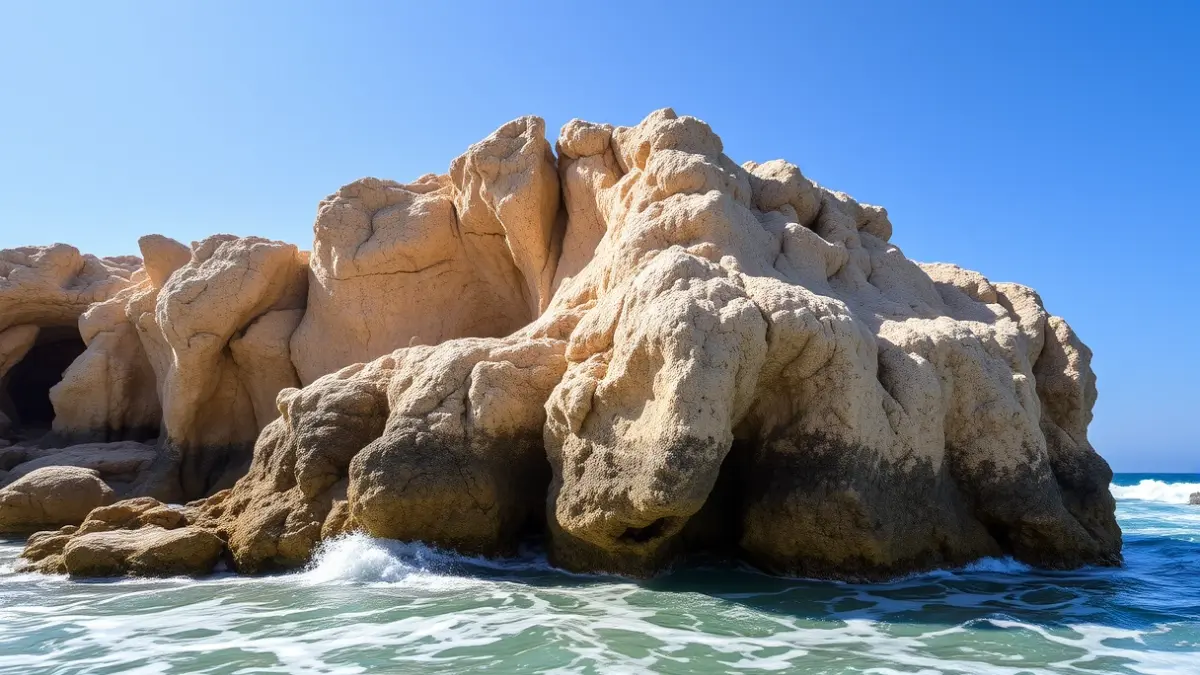
The unique rock formations along the coast of L'Escala are much more than mere stones; they represent popular memory, geology in action, and a landscape constantly transforming under the influence of the tramuntana wind, easterly storms, and human activity. These rocks serve as landmarks, viewpoints, and reminders, functioning as a true geological clock.
The maritime front, stretching from Mar d'en Manassa to Empúries and beyond to areas like Pedrigolet or Bol Roig, preserves a rich collection of popular names. These names, such as Roca del Cargol, Roca del Frare, or Arc del Portitxol, have allowed generations of locals to interpret their coastal environment.
The key to understanding this landscape is its constant evolution. The geological guide for Geolodia Girona 2025, focused on L'Escala and Empúries, highlights that the current coastline differs significantly from what the Greeks found over 2,500 years ago, when the area featured wetlands and a very active coastal dynamic. The document emphasizes that the landscape "continues to change" and the coast is shaped daily.
The Roca del Cargol, emerging in front of Mar d'en Manassa, is one of L'Escala's most iconic images. This formation, a low and elongated island battered by the waves, is visible from picturesque spots in the old town. Its importance is such that the official map includes the Mirador del Cargol and Carrer Cargol in this area. In 2025, the Town Council replaced the spotlight illuminating it, recognizing it as "one of the municipality's emblems".
The story of the Roca del Frare is particularly moving. This rock, which resembled a praying friar, sank on November 7, 1982, due to an easterly storm, causing significant emotional impact. After a failed attempt to reposition it in 1985, a group of locals rescued it, and the Town Council promoted its recovery as a monument on the promenade in 2009.
At Portitxol beach, near the Empúries promenade, the stone arch is a highly valued natural formation. The Geolodia Girona 2025 guide explains that it formed through preferential erosion, where waves removed weaker materials, leaving the more compact limestones that form the arch. This formation, like many others, has an "expiration date," and each storm shortens its lifespan.
The geological heritage of L'Escala is not limited to marine formations. The Roca d'en Massanet, known as the Roca del Lleó, illustrates how human action can transform a geological feature into an urban symbol. This large rock, located in the Oberta area, is the remnant of an ancient cliff excavated to widen the road. In 1965, the mayor completed the excavation, leaving the rock as a memorial, and in 2011, a commemorative plaque was placed.
The geological repertoire of L'Escala demonstrates that heritage does not always arise from an official declaration, but often from a shared name or a local history. All these rocks, according to experts, tell the same story: the coast is never still; it is a living frontier between stone, sea, wind, and memory.