The project 'Un Pop de Gram', initiated in 2022 with support from GALP, is entering a new phase to become a long-term study on octopus populations in the bays of Roses and Pals. The goal is to reverse the declining trend of this cephalopod by creating suitable spaces for their reproduction.
Driven by the Fundació Alive, with funding from GALP, collaboration from the Sèpia project, fishing guilds, and the support of the Aiguamolls and Montgrí natural parks, the project uses octopuses themselves as "samplers" of their environment.
The project's name refers to sea-grass (Cymodocea nodosa), a marine plant forming underwater meadows in both bays, which the octopus feeds on. Researchers are studying its diet, reproductive habitats, and food availability.
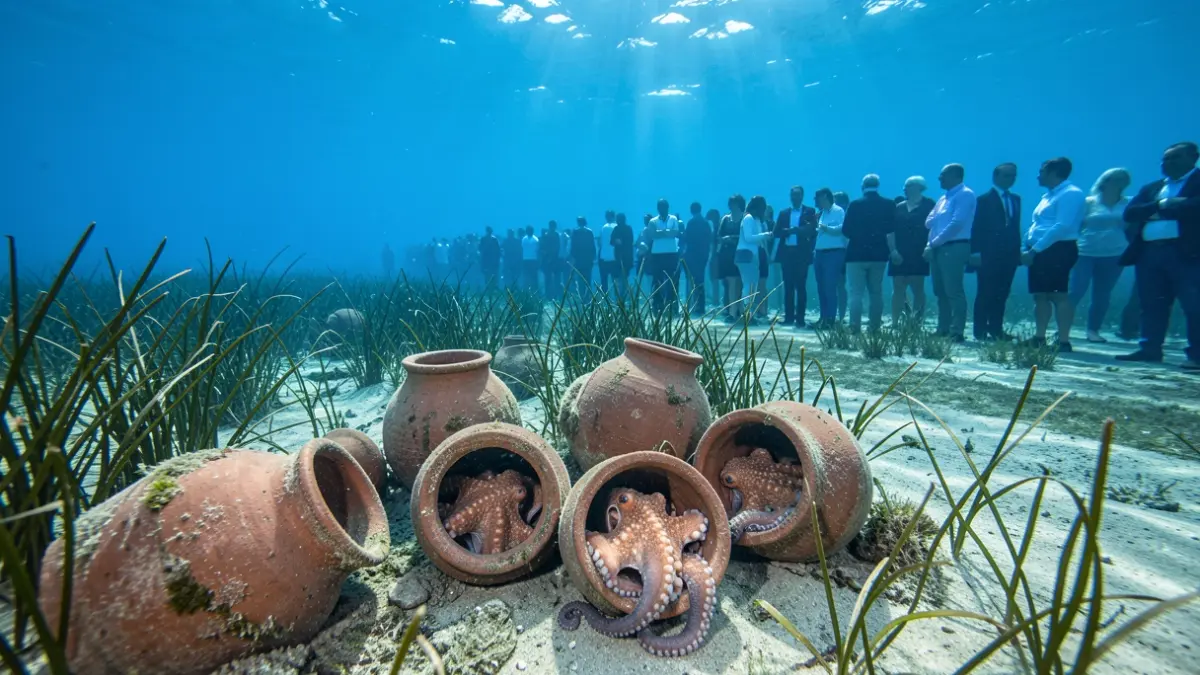
Two fixed lines have been installed on the seabed, off the coast of l'Escala and l'Estartit, each with 30 ceramic 'cadups' (containers). These pieces, handcrafted by Josep Matés using clay from Cruïlles, imitate historical models of black ceramics from the Empordà region.
Researchers conduct bi-weekly dives to inspect the 'cadups'. Octopuses use them as daytime shelters and bring their prey there to feed. The traces left behind provide information about their diet, reproductive status, and food availability.
An initial six-month study yielded interesting data. Now, with funding from Next Generation funds and the impetus of the Parc Natural del Montgrí, a fixed infrastructure has been installed to ensure research continuity. Signs of potential reproduction for next year have been observed.
During the six months of 2022, 43 octopuses were observed in l'Escala and 23 in l'Estartit, mostly small and medium-sized, with a diet based on clams. The aim is to detect population trends in the face of factors like rising sea temperatures or food availability.
The project also aims to verify if the 'cadups' improve the survival of the roquer octopus, which needs protected cavities for reproduction. Such natural shelters are scarce in sandy seabeds.
The initiative is inspired by the Sèpia Project, which creates artificial habitats for cuttlefish and squid. The first dives of this new phase have shown promising results, with a female and a male occupying a 'cadup'.
Beyond its scientific value, the project has an educational component, with future plans for controlled visits by divers to the facilities for environmental education.
Project coordinator Boris Weitzmann emphasizes the need for long-term monitoring to understand population trends and the impact of climate change, seeking collaborations and resources to ensure the study's continuity.