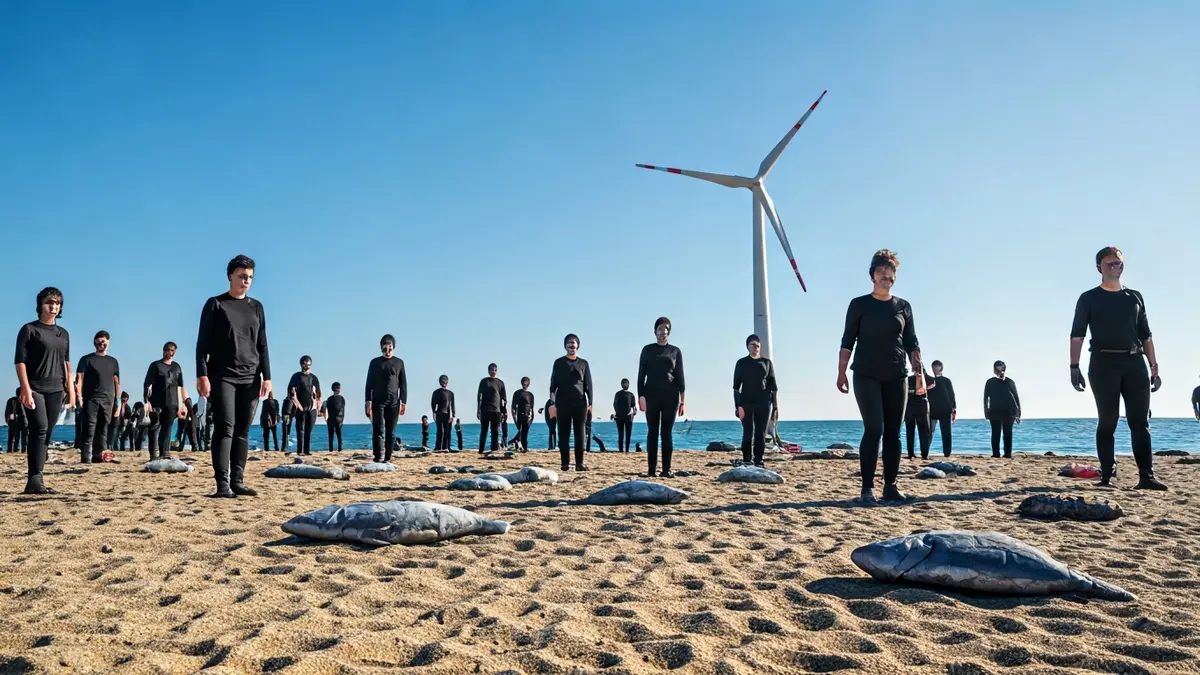
Dressed in black, participants staged the death of fish and birds to symbolize the harm they believe the project will cause to biodiversity. The action, organized by the 'No al Plemcat' platform, took place on les Barques beach in l'Escala, in the Alt Empordà region.
“"The implementation of the project responds to the interests of a few energy companies; we advocate for an alternative, decentralized model that utilizes already anthropized areas."
The performance was divided into three acts. Initially, accompanied by Vivaldi's music, balloons representing fish and seabirds were displayed, symbolizing the rich biodiversity of the Gulf of Roses. Subsequently, with the sardana l'Empordà, the local population was represented. Finally, to the soundtrack of Star Wars, a wind turbine on a platform approached the participants, who fell to the ground, staging the loss of biodiversity and quality of life.
Marta Ball-llosera, also a member of 'No al Plemcat', emphasized that the action's goal is to "once again, show opposition to the project." She added that the Generalitat is accelerating studies to promote a pilot test, the Plemcat, which would visualize how the park would specifically affect birds and fish, as well as the local population.
The platform warns that the environmental impacts would be "enormous" and that the project would mean "industrializing a marine sector." They recall that one of the proposed projects, Tramuntana, envisioned energy production comparable to that of a nuclear power plant, highlighting the magnitude of the intervention.
Marià de Delàs criticized that the project benefits "the interests of a few companies" within the energy oligopoly. He pointed out that the planned wind turbines would be "taller than the Sagrada Família" and, being floating, would require large anchoring systems that would damage the seabed. He also noted the terrestrial impact of electrical evacuation infrastructures, which would cross agricultural areas to the Vilaür substation.
The platform advocates for an alternative energy model based on distributed generation and energy communities, prioritizing already degraded areas. Several municipalities in the Empordà, as well as social, environmental, and agricultural organizations, have also positioned themselves against the project.
In early 2023, the State approved the POEM, designating the Gulf of Roses as the only point in Catalonia suitable for offshore wind farms, with an area of 250 square kilometers and a minimum distance of 12 kilometers from the coast. The Generalitat de Catalunya promoted the Plemcat as a pilot test with three floating wind turbines to test the technology before the potential implementation of commercial parks. Despite the procedures, no project has materialized yet.