The archaeological site of L'Abric Romaní, located in Capellades (Barcelona), is the focus of a new study led by IPHES-CERCA and published in the journal Science Advances. The research jointly analyzes wood remains recovered over more than 40 years of excavations, comprising nearly 600 items dated between 62,000 and 40,000 years ago.
According to IPHES-CERCA, stone tools have long dominated our understanding of Neanderthal technology, but wood, a perishable material, has rarely survived in the archaeological record. The study of remains from L'Abric Romaní indicates that Neanderthals made recurrent and diverse use of this raw material: as fuel, for crafting weapons, tools, domestic objects, and possibly for constructing or conditioning their living spaces.
The research, coordinated by Dr. Palmira Saladié (IPHES-CERCA / URV), involves a broad team of researchers from various Catalan and international institutions. The project is supported by the Departament de Cultura de la Generalitat de Catalunya, the Ajuntament de Capellades, and the company Romanyà-Valls, along with state and European funding.
The uniqueness of L'Abric Romaní lies in its exceptional preservation conditions, allowing for the tracking of wood presence over thousands of years across successive occupations of the same site. This enables the reconstruction not only of Neanderthal activities but also how they distributed tasks, managed resources, and organized their environment.
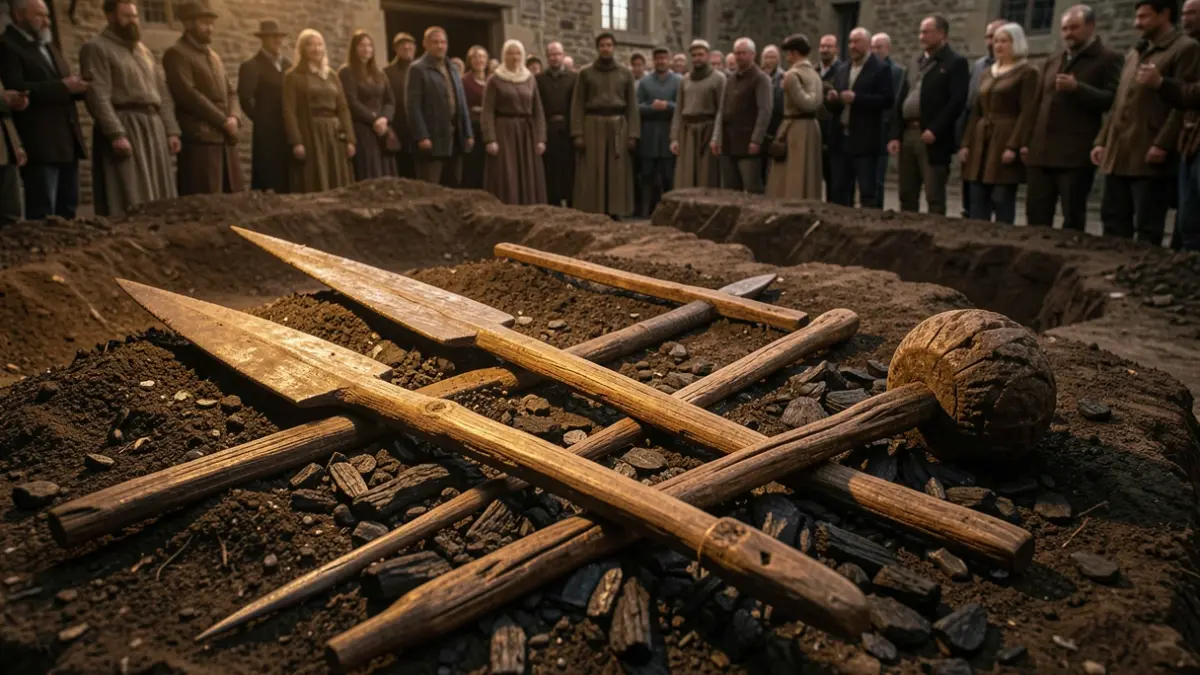
Among the identified remains are two wooden spears up to 2.45 meters long and an exceptional object interpreted as a possible mace. Possible bark containers, structures made of crossed poles, and a 5.10-meter piece that may have been used for conditioning the living space have also been found.
Wood complements the picture of Neanderthal technology, which for decades had been reconstructed primarily from stone. "Wood allows us to recover a fundamental part of the Neanderthal world that is usually invisible," concludes Dr. Josep Vallverdú (IPHES-CERCA / URV).
This study is the result of over four decades of continuous research at the site, initiated in 1983 and currently directed by Drs. Palmira Saladié, M. Gema Chacón, and Dr. Josep Vallverdú.