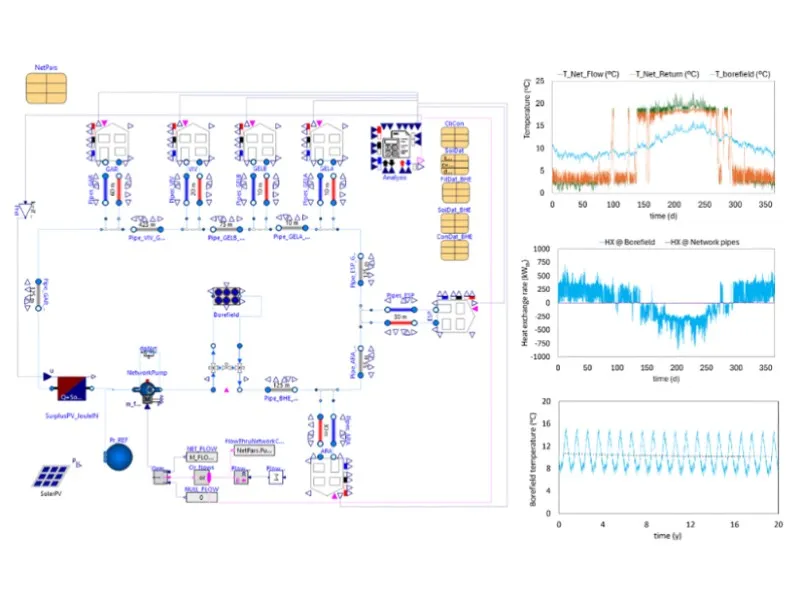
The tool, published as part of the European project FlexGeo, enables testing of different configurations and strategies before implementation, aiming to plan and optimize these energy networks. Geothermal energy is presented as a key solution for accelerating the decarbonization of towns and cities amidst increasing energy electrification.
GeoDENs allows for the evaluation of design and operational alternatives in terms of energy efficiency, economic cost, and emissions. The code is openly available for any professional to use. Fifth-generation District Heating and Cooling (5GDHC) networks are a promising alternative for decarbonizing heating and cooling demand, based on efficient energy exchange and local renewable resources like geothermal energy.
The release of GeoDENs is part of the activities within the European project FlexGeo, led by the Technical University of Munich (TUM), which aims to develop methodologies and tools to facilitate the adoption of geothermal solutions. The tool has been implemented in Modelica and validated with OpenModelica.
As a case study, GeoDENs incorporates the future heating and cooling network for Vielha, promoted by the Conselh Generau d’Aran. This network is planned to supply renewable thermal energy to various public and private buildings in the municipality.