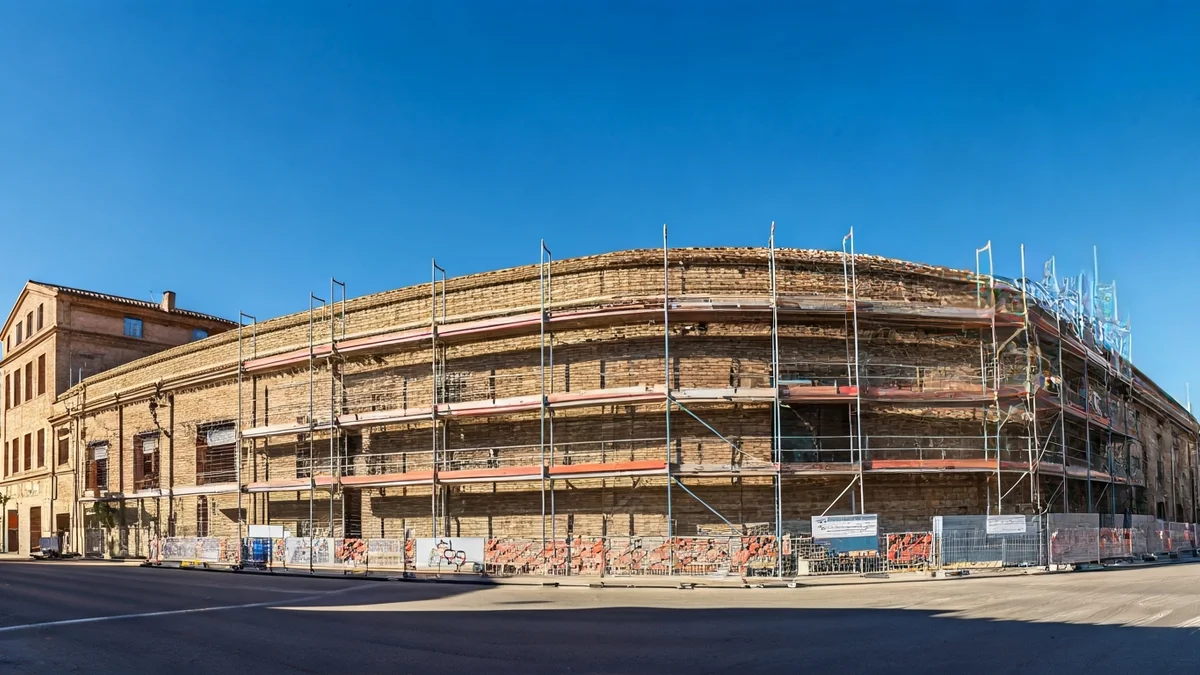
The Minister of Research and Universities, Núria Montserrat, visited the facilities of the Fàbrica Nova in Manresa this Monday to oversee the progress of the first phase of the works, which is expected to be completed by next April. This phase includes the rehabilitation of the roof, facades, and enclosures of the central nave.
During the visit, Montserrat reiterated the Government's commitment to the project, assuring that the remaining 6 million euros of the 10 million promised by President Salvador Illa will be provided during the current term, which ends in the summer of 2028. This investment adds to the 4 million already agreed upon last week.
“"A simple but necessary act to thank the Generalitat Government for the 4 million it agreed to last week."
The mayor of Manresa, Marc Aloy, thanked the Generalitat's involvement and highlighted that the Fàbrica Nova project addresses the need for decentralization and the promotion of knowledge. He recalled that the State has contributed 10 million euros, the Diputació 1.5 million, and the City Council has invested 12 million in the acquisition of the building. For the interior works, an additional 30 million euros are foreseen, with one million contributed by the City Council and one million by the UPC for the tender.
The rector of the Universitat Politècnica de Catalunya-BarcelonaTech (UPC), Francesc Torres, emphasized the deep roots of engineering in Manresa and the potential of the Fàbrica Nova as a hub for knowledge, research, and innovation. He compared its impact to that of the UPC's Diagonal-Besòs Campus in urban and social regeneration.
Minister Montserrat highlighted the UPC's value as one of the most prestigious universities in engineering and stressed the importance of territorial equity, aiming for academic excellence and innovation to reach throughout the territory. She mentioned that the Fàbrica Nova will host a thousand students and offer 'training capsules' to bring the productive sector closer to knowledge.
The project architects, Manuel and Josep Maria Julià, detailed the complexities of the rehabilitation, which has included the restoration of original elements, the cleaning of 60,000 tiles, and energy improvements. The first phase, concluding in April, has involved an investment of 10 million euros and 20 months of work, transforming a building inactive for 35 years into a future reference center.