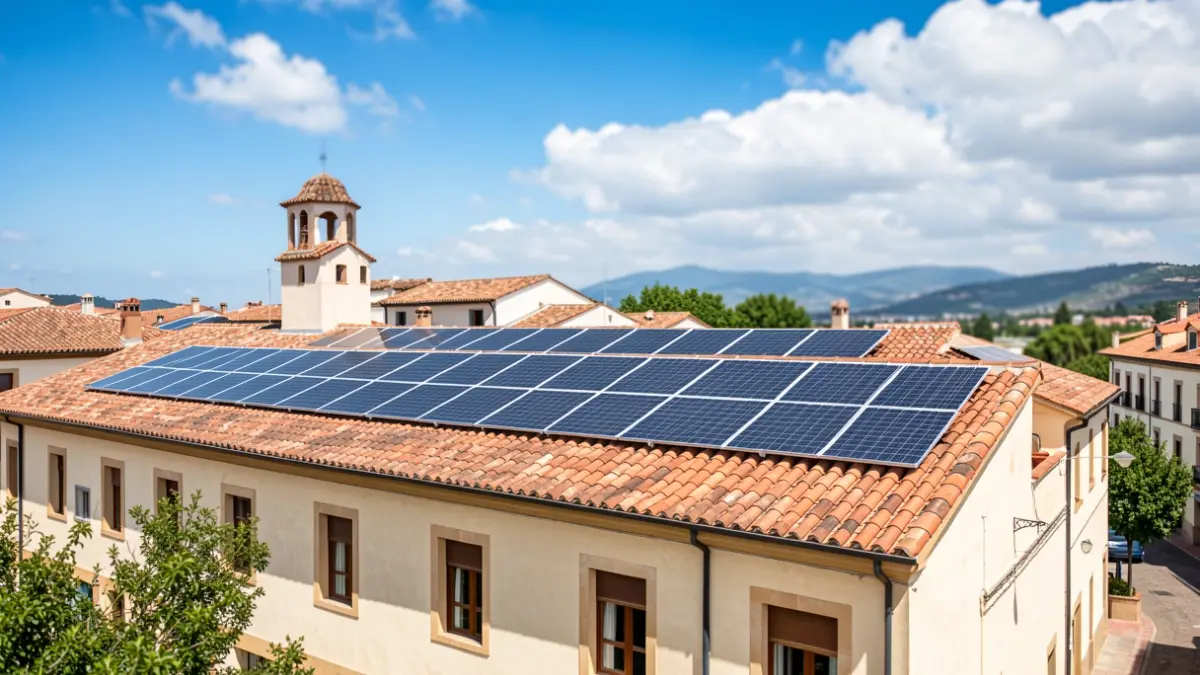
The initiative, which has already seen panels installed in 107 centers, will expand to include 234 more in the coming months. This will enable over half of the viable centers to have photovoltaic technology, with plans to extend it to the rest in the future.
This project is part of the decarbonization strategy for Catalan public services, set for 2040. It also aims to improve educational center conditions against high temperatures, as currently only one in ten centers is air-conditioned.
At the Lluís de Peguera Institute in Manresa, for instance, 260 solar panels have been installed, generating 187 megawatt-hours annually, equivalent to the consumption of about fifty homes. Lluís Casellas, head of Solar Self-Consumption at L'Energètica, highlights that the campaign seeks to provide clean, secure, and sovereign energy while reducing electricity bills.
The collective self-consumption model will allow surplus energy from the institute to benefit nearby public facilities, such as the adjacent Primary Care Center. This energy can be shared with other public installations within a 5-kilometer radius, including Mossos d'Esquadra police stations or judicial facilities.
Once the campaign is complete, L'Energètica will have an installed capacity of 56 MW across 341 rooftop installations in institutes. The geographical distribution includes 177 centers in the Barcelona metropolitan area, 52 in the Girona region, 44 in Camp de Tarragona, 34 in Penedès, 21 in Central Catalunya, 6 in Ponent, 4 in Terres de l'Ebre, and 3 in Alt Pirineu i Aran.