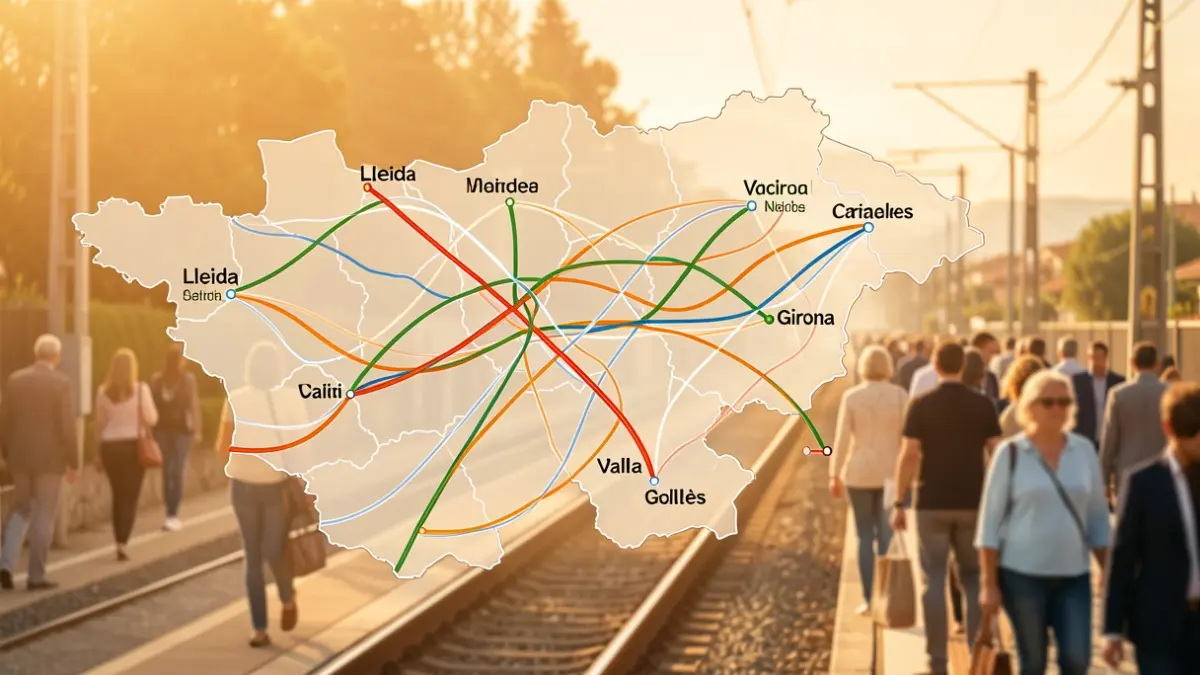
The project includes a station in the Vallès region, yet to be determined, which would allow for connections with Rodalies and FGC commuter lines. This new route will also facilitate the access of high-speed trains (AVE) from Madrid to Barcelona via La Sagrera, through a branch line between Martorell and Mollet. The Minister of Territory, Sílvia Paneque, emphasized that the axis will "reinforce" the current network in terms of "capacity, efficiency, and balance," considering it a "strategic infrastructure."
The study, with an estimated cost of 1.5 million euros and a 28-month deadline, will delve into existing routes and new regulatory requirements. The project, originating in 2003 and approved in 2010, was later shelved. The planning for the first section, between Lleida, Igualada, and Martorell, and the entry into Barcelona via La Sagrera, are the initial objectives.
Urban architect Manel Larrosa welcomed the fact that the tender does not specify the exact location for the Vallès station, anticipating diverse proposals and the incorporation of public input. Larrosa advocates for integrated planning that balances high-speed rail, freight transport, and other pending projects, such as railway links, considering elements like the Vallvidrera or Horta tunnels.
The contract specifications, managed by Ifercat, stipulate that the new line's route will be "substantially parallel" to the R8 Rodalies line between the Rubí tunnel and Mollet-Sant Fost. The Government plans for high-speed trains to stop at a minimum of one station per county. Larrosa, representing FemVallès, suggests viewing the Vallès station as a "third station for Barcelona," questioning mandatory consecutive stops and noting the divergence between state and regional government proposals.
Marc Taulats from the Association for the Promotion of Public Transport (PTP) views the study as functional and embryonic, highlighting a conflict between the Ministry of Transport and the Generalitat. The Catalan executive aims to establish its perspective before the Spanish government proceeds with its high-speed rail plan. Minister Óscar Puente had previously proposed direct AVE access from Lleida to Barcelona-Sagrera, bypassing Camp de Tarragona and Sants, with a route parallel to the A2 to Martorell and then following the R8 to Mollet.
The Generalitat's proposal, conversely, suggests a mixed freight and passenger axis parallel to the C-25. Taulats summarizes that the current study seeks to reconcile both approaches, although no report is binding. The orbital line, passing through Sabadell, is also gaining momentum as a parallel project, having been a key element in budget negotiations.