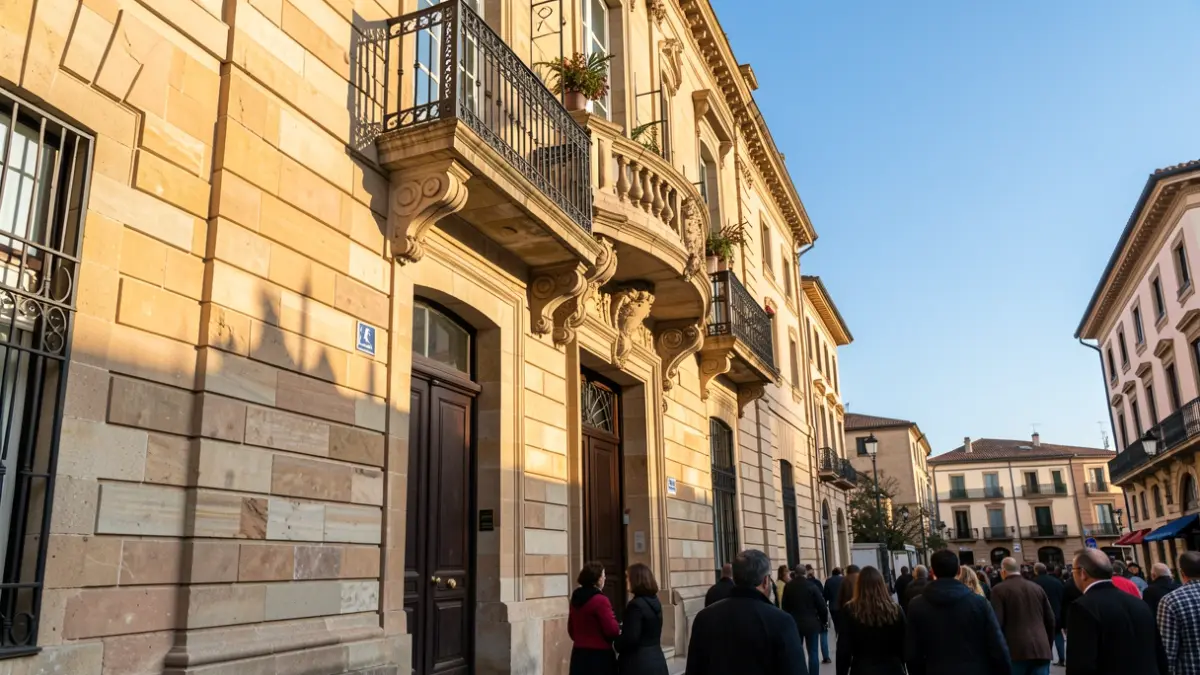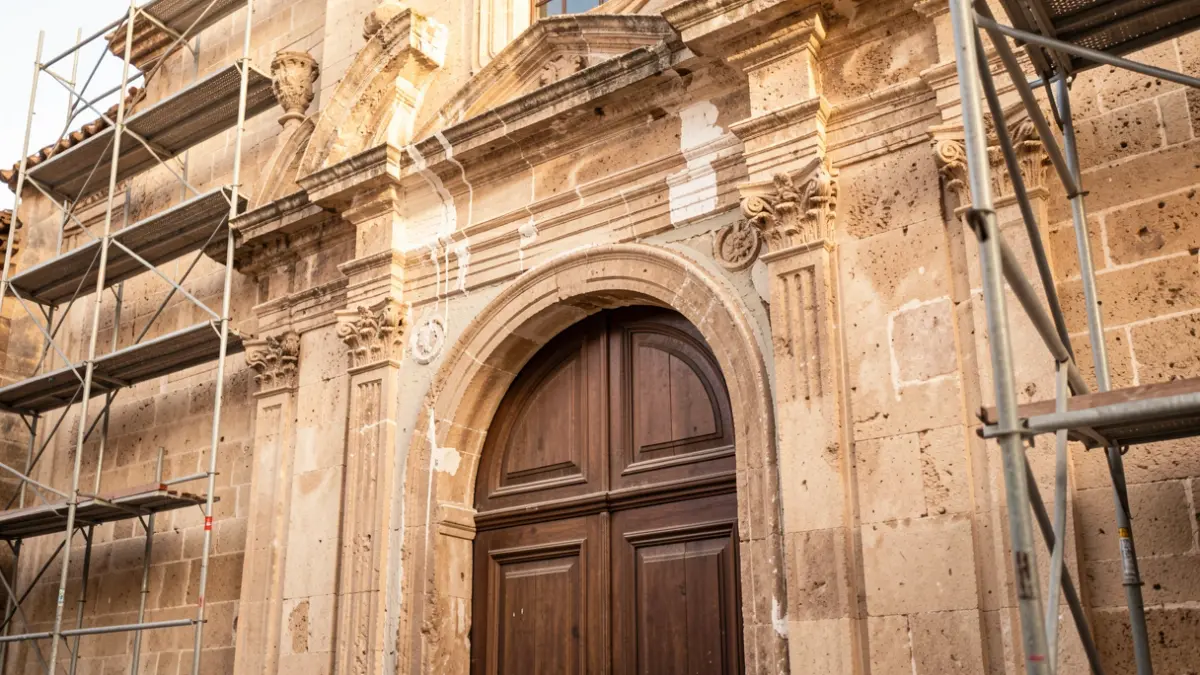
The parish of Alfara de Carles and the Diocese of Tortosa have promoted the conservation and restoration of the baroque portal of the Sant Agustí church. The works were carried out during February and March 2026 and were directed by the restorer Júlia Poy Estrada. The specialized construction company David Cid Curto also participated in the intervention, which had a total cost of 20,885.33 euros.
This heritage element of architectural and historical interest presented various degradation processes due to continuous exposure to atmospheric agents, the presence of humidity, and the use of inadequate materials in previous interventions. The main objective of the intervention was to ensure its material stability, improve its preventive conservation conditions, and restore its architectural and aesthetic readability, in accordance with criteria of minimal intervention, compatibility, and reversibility typical of heritage restoration.
The executed works consisted of the elimination of biodeterioration, adhered surface deposits, and saline accumulations through specific treatments, controlled cleaning, and mechanical and wet procedures applied to the stone surfaces. These actions allowed for the removal of incrustations, crusts, and other superficial alterations, ensuring at all times the preservation and non-alteration of the original surface. Likewise, incompatible Portland cement mortars from previous interventions, responsible for internal tensions, moisture retention, and accelerated stone degradation processes, were removed.
The intervention also included the consolidation of areas with disintegration and loss of material cohesion, the sealing of fissures and cracks to prevent the entry of water and contaminants, and repointing with lime mortars specifically formulated to ensure compatibility in terms of physical, mechanical, and chromatic properties with the original materials. Furthermore, punctual reintegrations of the support were carried out in areas where volumetric losses favored new degradation processes.
In parallel, external elements such as cabling, anchors, and oxidizable metal fixings, which altered the aesthetic reading of the ensemble and could generate pathologies associated with oxidation and moisture penetration, were removed from the facade. Before the execution of the final treatments, preliminary tests for cleaning, consolidation, and mortar formulation were conducted to verify their effectiveness and ensure the compatibility of the employed materials with the originals.
Regarding the results obtained, the recovery of a more homogeneous and coherent reading of the portal stands out, as well as the improvement of the architectural and ornamental perception of the ensemble. The intervention has reduced active degradation processes, superficially stabilized the stone materials, and eliminated incompatible materials, risk elements, biological proliferations, and superficial saline accumulations.
Finally, it should be noted that the Provincial Council of Tarragona granted a nominative subsidy corresponding to the 2025 annuity for the execution of the project. In this regard, the Governing Board of the Provincial Council of Tarragona, in a session on November 11, 2025, agreed to award a subsidy amounting to 7,000 euros.