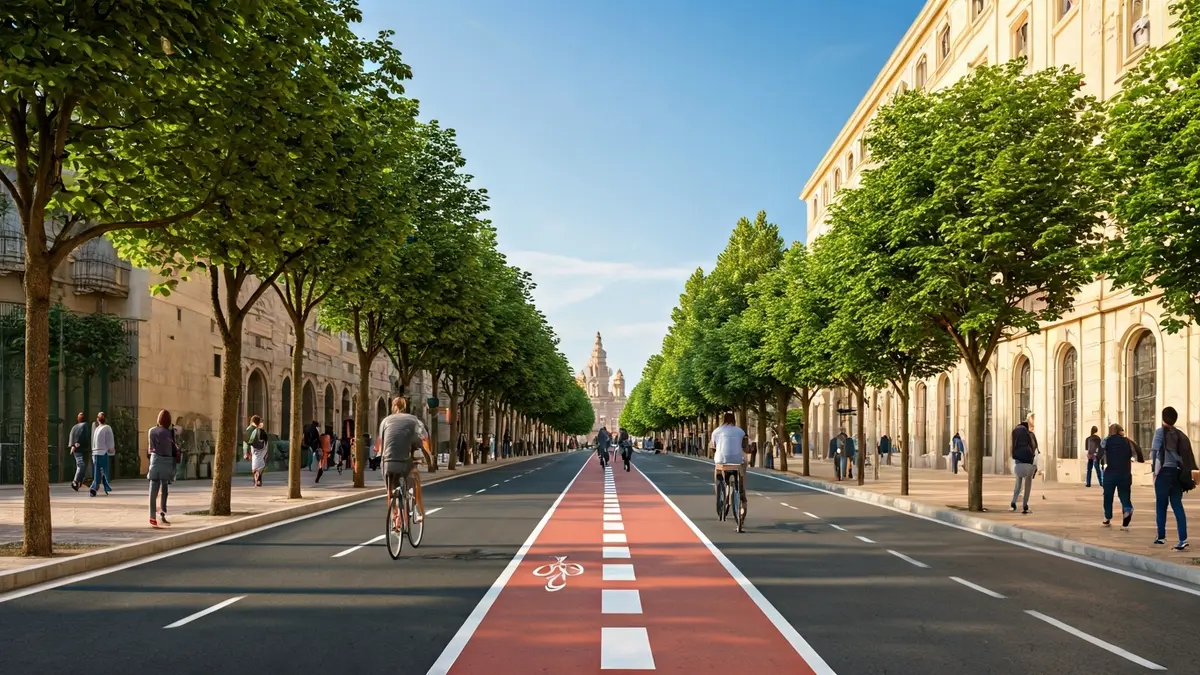
The transformation of the former N-340 into a peaceful urban axis in l'Aldea, in the Baix Ebre region, is about to enter a new stage. The municipalities affected by the old thoroughfare, which ceased to carry the bulk of traffic almost a decade and a half ago, continue to work on converting it into a more pleasant space for residents and businesses.
Merchants like Mercè Tafalla and her son Marc Borràs, the third and fourth generation of a family business with seven decades of history, have been direct witnesses to the road's impact. From their shop, located at the intersection of the old N-340 and the N-235, they recall the initial fear when traffic was diverted on October 3, 2013. The concern that the town would become a ghost town, losing customers who used to pass through, was palpable.
“"It was very inhumane: the noise, the pollution... The windows would turn black and every two or three days you had to clean them. Now it's much better: we are happier, it feels more like a town. Cars still pass, but it's more fluid, it's town traffic."
Thirteen years later, those fears have dissipated. Merchants have found that, far from losing customers, the quieter and less aggressive environment has attracted new visitors. The mayor of l'Aldea, Xavier Royo, admits that the uncertainty was significant, as between 25% and 30% of local business directly depended on the road.
In early 2019, the Spanish government transferred ownership of the thoroughfare to the Town Council, initiating a redevelopment and pacification project for the 2.3 kilometers of the old N-340 and the urban section of the N-235. The first two phases, which involved an investment of 1.15 million euros and redeveloped 1.5 kilometers with trees and a bike lane, have already been completed. Now, the third and fourth phases are expected to be tendered for an additional 800,000 euros, with an estimated total cost of 5 million euros, financed through subsidies and own resources.
The transformation has forced businesses to reinvent themselves, offering new products and services. Improved mobility and reduced traffic have allowed residents and visitors to enjoy the town more peacefully, eliminating the pressure previously generated by constant vehicle passage. Furthermore, the redevelopment has helped to connect the Estació and Hostal neighborhoods, historically separated by the road.
“"No one has told me they miss the road for any reason, not at all, because the town has gained a lot in tranquility, traffic has been greatly pacified."
Mayor Royo concludes that the town has managed to overcome the loss of what was considered a vital artery, gaining in tranquility and quality of life. The development of the Catalunya Sud industrial park has also been key to maintaining commercial activity in the municipality.