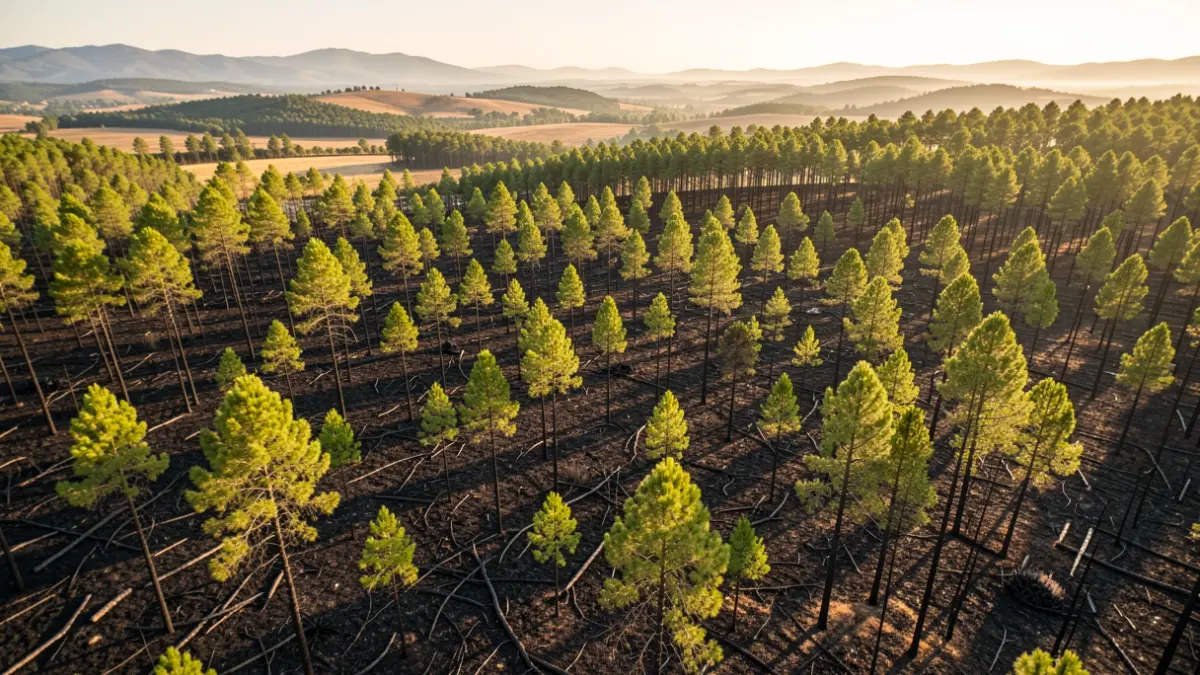
A total of four forestry companies have been tasked with removing trees burnt in the fire that affected Paüls, in the Baix Ebre region, last summer. For the first time, an innovative model has been implemented where administrations act as intermediaries to organize timber extraction and boost the management of affected properties. This initiative has led to the design of twelve lots to make the operation profitable for timber companies while sparing farmers the additional cost of removing the burnt wood.
As highlighted by engineer Jordi Galofré of Gil Forestal, coordination between administrations and landowners has been crucial for intervening in many plots. The high fragmentation of property in the Ebre agricultural mosaic made it difficult to locate many of the owners of the properties affected by the fire, which occurred last July.
The Departament d'Agricultura of the Generalitat, along with the town councils of Paüls, Xerta, Alfara de Carles, Aldover, and Tivenys, have collaborated with the over 2,000 affected owners to organize the extraction of burnt timber. This pioneering model has facilitated a more orderly and efficient operation, preventing property abandonment, reducing erosion risk, and mitigating pest problems.
The main objective was to operate on as many properties as possible to prevent land degradation, which affected over 3,300 hectares. Administrations have delineated the affected area into twelve lots, which have been distributed among forestry companies with the owners' authorization. Four timber companies have been working on these lots for several months.
Eusebi Casanova, a forestry engineer from the Departament d'Agricultura, described the results as "more than satisfactory," noting that in other large fires with many owners, they have encountered "many problems" in cutting timber. He emphasized the need for municipal involvement and the acceptance of lot distribution by residents and companies.
The mayor of Paüls, Enric Adell, defended the initiative as positive for territories with high fragmentation of forest ownership, such as the Terres de l'Ebre, as it allows properties to recover their condition without cost to those affected. Genís Espinós, one of the beneficiary farmers, welcomes the measure, which saves farmers money and applies circular economy principles.
Despite the progress, some farmers like Genís Espinós express concern about the pace of operations, calling for a clear timeline to fully recover the properties and prioritizing the clearing of cultivated plot perimeters due to the fire risk from accumulated undergrowth.
The company Gil Forestal SL, from Peñarroya de Tastavins, is clearing around 200 hectares and utilizing the timber, mainly white pines, for biomass. Engineer Jordi Galofré explains that burnt timber, once its bark is lost, is no longer optimal for sawn wood but is suitable for chips and pellets for industrial boilers.
In addition to timber removal, the heavy machinery operations are creating a network of forest tracks and access routes that improve accessibility and facilitate future forest management and fire prevention tasks.
During operations, forestry companies exercise extreme caution due to the potential presence of war material from the Spanish Civil War, having found remnants of mortar bombs that are removed by the Mossos d'Esquadra.
The mayor of Paüls, Enric Adell, reminds that the Generalitat still needs to carry out actions on the burnt public forest, warning of the land's vulnerability to erosion and the need for intervention before new heavy rains.
The economic compensation system for areas declared catastrophic zones is also questioned, considered an insufficient "patch" by farmers like Genís Espinós, who calls for individualized assessments to cover significant losses not covered by the 10,000 euro cap.