The third Costa Brava Debate, held in 2004, highlighted the concerns accumulated over decades regarding the future of the Girona coastline. This was not a new discussion; as early as 1935, the Generalitat republicana had initiated similar conferences, followed by a debate organized by Presència magazine in 1976 and another by the Girona Architects' Association in 1988. The 2004 congress presented itself as a crucial opportunity to review a growth model that had been generating tensions for a long time.
Despite changes in context, the problems persisted. The coastline had grown around tourism, construction, and second homes. Critical voices warned of the rapid consumption of the landscape, permissive urban planning decisions, and the failure to implement conclusions from previous debates. The Revista de Palafrugell, in March 2004, directly questioned whether there was still time to change course.
Promoted by the Girona Architects' Association under the slogan "A Sustainable Future," the congress unfolded over four sessions. The first took place in Roses on March 5th, the second in Palafrugell on March 19th, the third in Blanes on April 2nd, and the closing session in Sant Feliu de Guíxols on April 16th. The Palafrugell session focused on mobility and infrastructure, sensitive points for the future of the Costa Brava.
Prior to the official session, the municipality had already hosted on February 13th the screening of the documentary Els límits de la Costa Brava (The Limits of the Costa Brava), organized by the Arítjol association in collaboration with the Town Council. The film contrasted historical images with the current reality, questioning the capacity to continue "squeezing" the coast. The event, attended by about two hundred people, debated speculation, political responsibility, and sustainability.
The session on March 19th in Palafrugell, summarized by Santi Massaguer in the Revista de Palafrugell with the headline "No more ports, no more roads," was particularly significant. The highlight was the announcement by Manel Nadal, Secretary General for Mobility of the Department of Territorial Policy and Public Works, who confirmed that the Government did not plan new marinas or the coastal transversal highway, proposing dry marinas to accommodate boat demand.
This announcement closed the door to major infrastructure projects but maintained pressure on the coastline. Dry marinas, while reducing construction impact, did not resolve the increase in boats, cove saturation, anchoring, and seabed degradation.
The mayor of Palafrugell, Lluís Medir, advocated for a broader vision of the Costa Brava, incorporating the hinterland and proposing municipal groupings with supramunicipal authority. He also called for coherent public transport and a new financing policy.
The session also revealed divergent viewpoints. Civil engineer Robert Vergés argued for extending the coastal highway to the French border, citing the area's infrastructural lag. He noted that on a summer day, traffic between Palamós and Palafrugell exceeded 50,000 vehicles.
This proposal clashed with the positions of Manel Nadal and Lluís Medir, who opposed the duplication of roads around the Gavarres, advocating instead for strengthening public transport and reviving the old "carrilet" (tramway).
The environmental dimension was emphasized by Jordi Sargatal, director of the Fundació Territori i Paisatge (Territory and Landscape Foundation), who called for the preservation of natural spaces and the valorization of existing heritage.
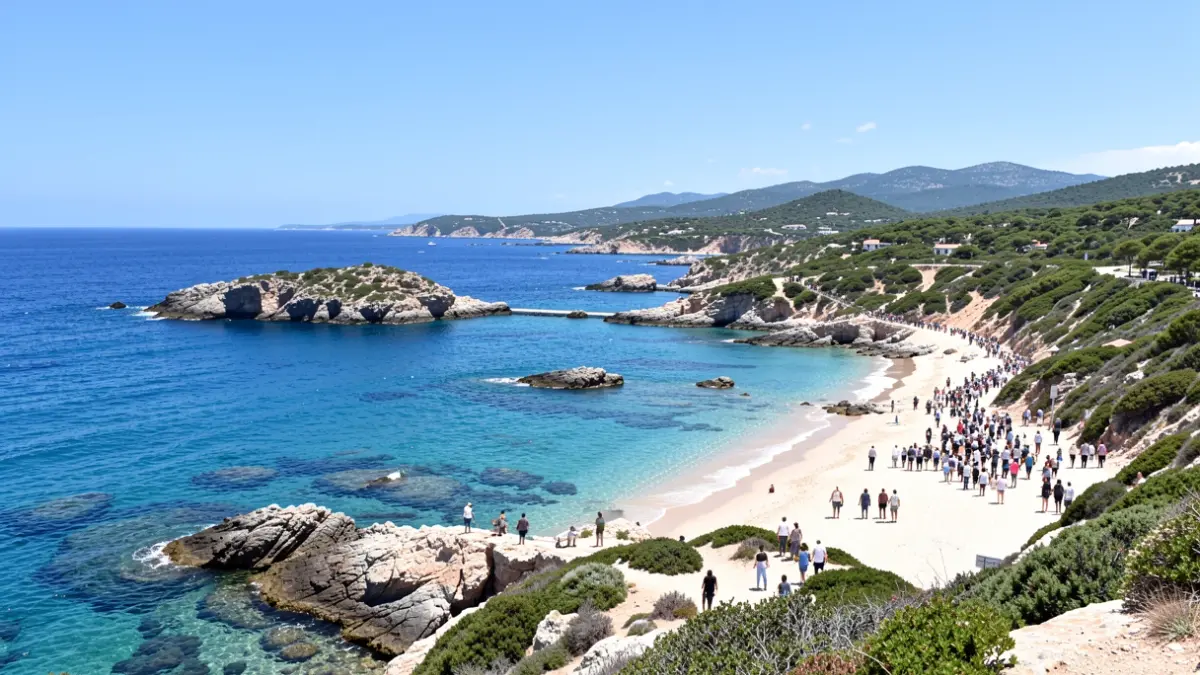
Concurrently, an article in the magazine warned about the high density of moorings on the Costa Brava and the impact of navigation and anchoring on coves, swimmers, and seagrass (posidonia), calling for measures to curb its degradation.
Despite the relevance of the topics, the Palafrugell session left an incomplete feeling, with conclusions reserved for the closing in Sant Feliu de Guíxols. Massaguer lamented the low citizen participation.
The April conclusions were met with skepticism by the Revista de Palafrugell, which recalled that 27 years after the first debate, the situation had worsened in aspects such as urban saturation, mass tourism, and environmental degradation.
The magazine questioned the spontaneity of the conclusions, which sounded predetermined despite their adoption by Councillor Joaquim Nadal. The doubt remained about the transition from theory to practice.
The Crònica d’un any 2004 placed the debate within a broader context, including the Table for Sustainable Development convened by environmental groups, who considered the Costa Brava Debate "artificial" and insufficiently focused on real sustainability policies.
On March 19th, 2004, Palafrugell witnessed a debate that went beyond infrastructure, touching upon tourism models, governance, real estate pressure, and environmental limits. The Costa Brava approached this juncture with decades of accumulated growth and the pressing need to prevent tourism and real estate demand from continuing to dictate its future.
That session did not resolve the future of the Costa Brava, but it documented a key moment in the attempt to establish order and limits for a coastline under pressure. The 2004 debate firmly placed the issue back at the center of the agenda.