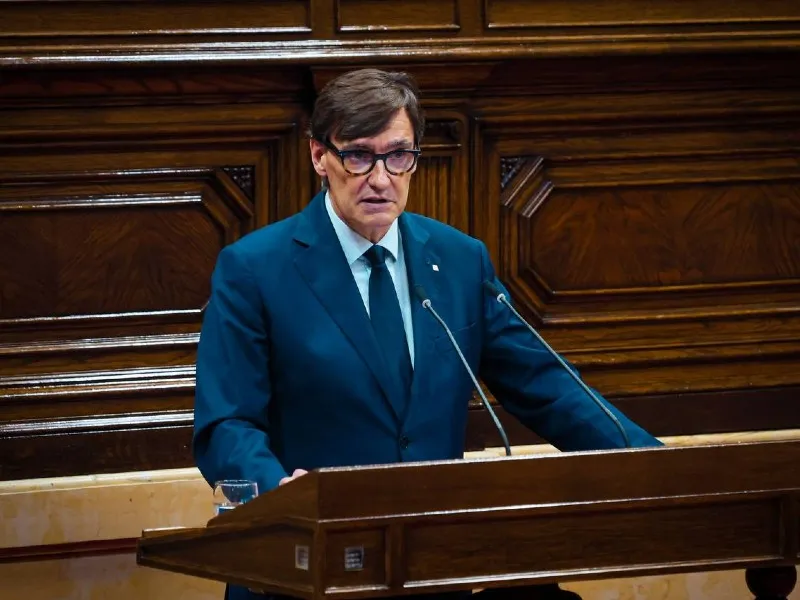
Jéssica Albiach, the Comuns' parliamentary leader, stated that the new budget agreement with the Generalitat "needs more ambition and a greater sense of country." Albiach stressed that the party does not want to set deadlines for evaluating the executive's proposals, despite sensing "a certain haste" from the government to approve the budget. These remarks were made today in Viladecans (Baix Llobregat) during the Sant Isidre fair.
Albiach recalled that the negotiations extend beyond 2026, as this is a "legislature budget" intended to cover 2027 and 2028 as well. Regarding housing, she proposes a "real leap" with an investment of 2.5 billion euros. She also advocates for doubling the Neighborhood Plan annually, allocating 400 million euros to intervene in forty neighborhoods each year, and urges the "urgent" processing of a law to accelerate the conversion of offices and commercial premises.
Concerning mobility, she described the Rodalies commuter rail network as a "minefield" and believes the R-Aeroport line should be managed by Ferrocarrils de la Generalitat, be accessible to residents, and connect to both Vallès Occidental and Oriental, not just serve tourists. In the fight against inequality, the Comuns propose a law to implement the Zucman tax, which requires assets over 100 million euros to contribute at least 2% in taxes, with an estimated revenue of 5.2 billion euros.
Regarding the teachers' mobilizations, Albiach urged the government to present a "firm" proposal at the meeting with educational unions, reminding them that they are "not asking for privileges" but "resources to do their job well." She noted that they are coming from "decades of underfunding" and that classroom complexity is "increasingly greater," expressing support for the mobilizations and calling for renewed negotiations with a "forceful" proposal.
In response to Junts' call for a national agreement on education, Albiach demanded consistency, recalling the austerity measures of Convergència i Unió. She expressed confidence in reaching an education agreement, stating that "the hardest part has already been achieved, which is getting the government and unions back to the negotiating table," and does not foresee a scenario where the government is "incapable of reaching an agreement with the educational community."