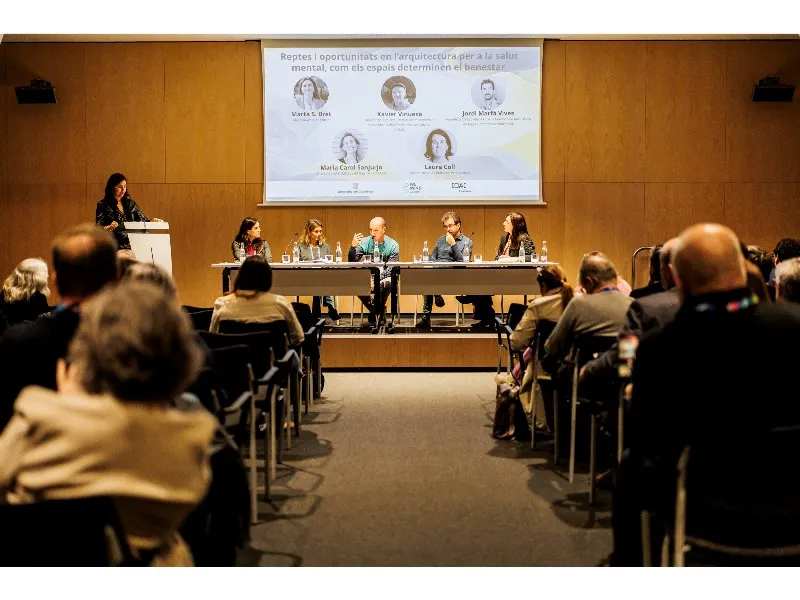
The conference "Spaces that Care and Cure: Architecture, Urbanism and Mental Health," driven by the National Pact for Mental Health (PNSM) and WeMind Cluster, has underscored the importance of built environments in mental health prevention, care, and recovery. The event, held within the framework of the Smart City Expo World Congress, gathered professionals and institutional representatives to reflect on how spaces can become mental health assets.
The director of the PNSM, Laia Arnal, emphasized that "mental health does not depend solely on healthcare, but also on the conditions and environments in which we live our lives. The spaces where we live, work, study, or receive care can foster emotional well-being, social relationships, and recovery processes, but they can also create barriers and inequalities." She highlighted that "incorporating the perspective of mental health into architecture and urbanism means advancing towards a more inclusive society that places people and their needs at the center of decisions."
For her part, the director of WeMind Cluster, Marta S. Bret, pointed out the challenge of "ensuring that all this knowledge translates into concrete decisions when designing the environments where we live, work, and interact." She added that "we need to connect architecture, urbanism, research, health, and the business sector to drive innovative solutions that place people's well-being at the center."
Throughout the conference, discussions covered how factors such as natural light, noise, space distribution, accessibility, contact with nature, and opportunities for social interaction influence emotional well-being. The need to incorporate these criteria into urban planning, housing, workplaces, and health and community facilities was highlighted. Presentations by Clara Rius, a specialist in conscious design and neuroarchitecture, and architect Patricio Martínez, offered a comprehensive view of the relationship between architecture, health, and community.
Practical experiences were shared, including the therapeutic garden at Fundació Hospitalàries Sant Boi, the Kàlida project, initiatives by Osonament, proposals for designing workplaces focused on emotional well-being, and the perspective of housing and public planning with the participation of the Institut Català del Sòl (INCASÒL).
The final debate brought together representatives from WeMind Cluster, Suara, Barcelona City Council, the Hospital de la Santa Creu i Sant Pau, and the public health sector. The need to strengthen interdisciplinary collaboration and move towards architecture and urbanism models that integrate emotional well-being from the early planning stages was addressed.
This conference is part of the "Mental Health, a Shared Vision" cycle, promoted by the Government, which will organize eight technical and territorial meetings across Catalonia during the second half of 2026 and the first of 2027. The cycle aims to create spaces for connection and community building among administrations, professionals, entities, universities, companies, individuals with lived experience, and citizens to foster alliances and advance towards a transversal and community-based response to mental health challenges.