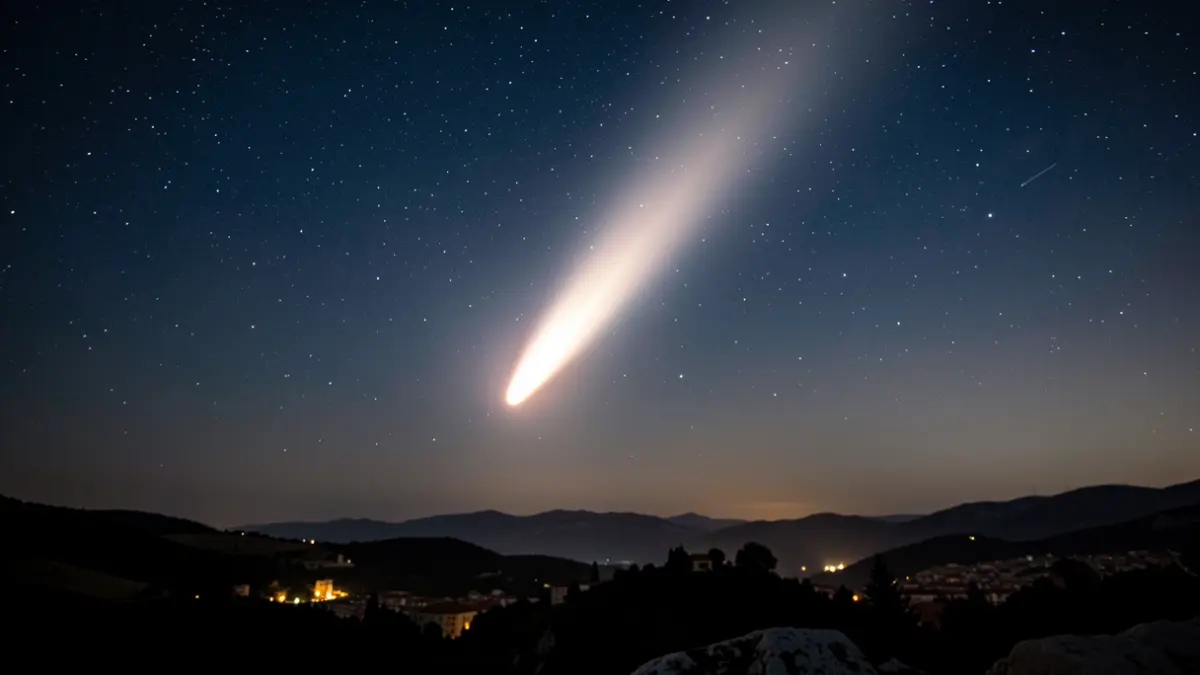
The Catalan sky briefly illuminated last night due to the presence of a superbolide. The fireball, a result of a rock fragmenting at hypervelocity upon entering Earth's atmosphere, was detected around 2:30 AM. Sources from the network for the Study of Fireballs and Meteorites (SPMN), coordinated by the Institute of Space Sciences (CSIC-IEEC), confirmed the event.
According to Josep M. Trigo i Rodríguez, a scientific researcher at ICE-CSIC, a fireball is the luminous phenomenon caused by the ablation of a rock originating from interplanetary space. The distinction from a meteorite lies in whether the rock survives its atmospheric entry and reaches the Earth's surface.
These fragments, known as meteoroids, travel at extreme speeds. When Earth intercepts them, the interaction with the atmosphere generates a luminous trail called a meteor. The brightest meteors are termed fireballs, and their study helps reconstruct trajectories and locate potential meteorite falls.
Thursday's superbolide was captured by about ten video detection stations in Catalonia and Valencia, including locations such as Pic Bartolo, Breda-Girona, Catarroja-València, Esparreguera, Folgueroles, Gavà-Colomeres, the Montsec Observatory, the Pujalt Observatory, Sant Fost de Campsentelles, Sant Mateu, and Vallirana. It was also recorded by the French FRIPON station in Marseille.
Dr. Trigo i Rodríguez detailed that the entry speed into the atmosphere was approximately 140,000 kilometers per hour. This type of luminous event, classified as a superbolide, is infrequent and may only be visible a few times a year across the Iberian Peninsula.
The Network for the Study of Fireballs and Meteorites, with over 30 years of history, is a citizen science project that has led to the recovery of three meteorites. According to Trigo, prior to their work, no meteorites had been recovered in the region for 57 years.