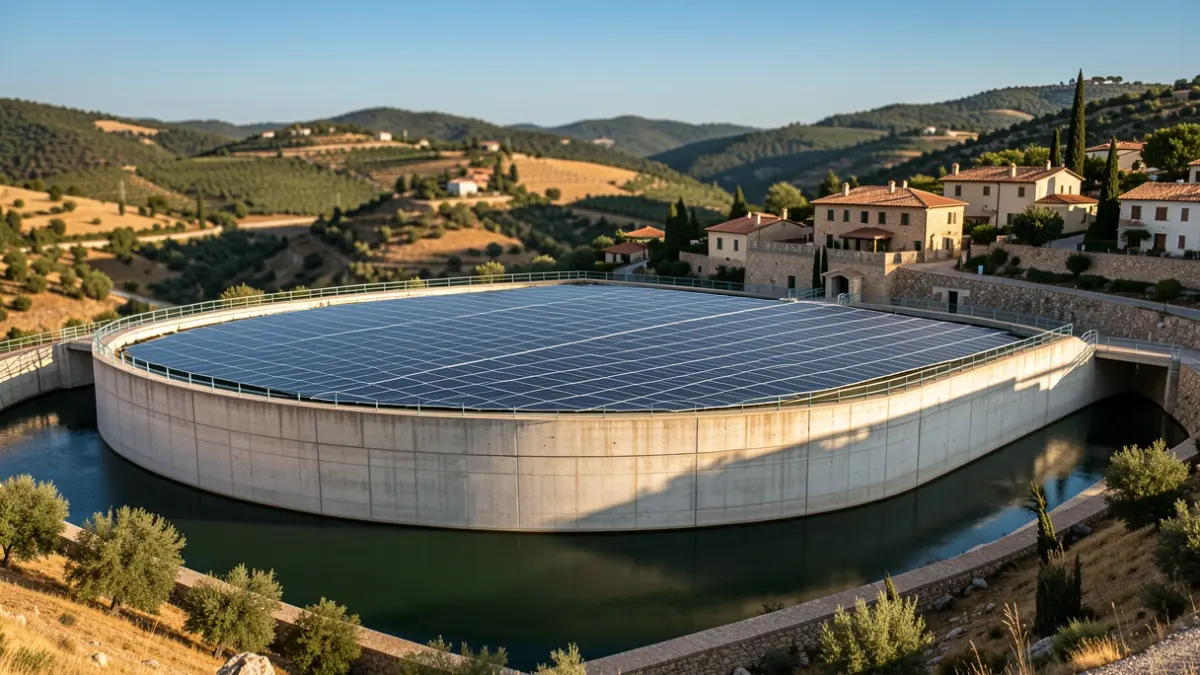
The Consorci d’Aigües de Tarragona (CAT) has opened the doors of its new regulating reservoir in Cunit, marking a turning point in the energy management of its network. This facility is the first in the CAT network to operate entirely autonomously thanks to an integrated photovoltaic park.
The reservoir's roof hosts 364 solar panels capable of generating up to 200 kWp, sufficient power to operate both the facility itself and the electrochlorination station. This energy solution, costing 253,000 euros, utilizes existing industrial space without occupying new natural areas. A significant portion of the funding, 120,000 euros, comes from European NextGenerationEU grants.
This is the CAT's 47th regulating reservoir, but the first to achieve energy self-sufficiency. Consortium President Marc Brunet highlighted that this decarbonization model, using rooftops for renewable energy production, serves as a blueprint for the entity's future. Currently, about 10% of the energy consumed by the CAT is self-produced, with a goal to reach 15%.
With a capacity of 25,000 cubic meters, equivalent to ten Olympic swimming pools, the new reservoir covers 5,400 m² and required an investment of over 5.6 million euros, co-financed 50% by the Catalan Water Agency (ACA) and the CAT. ACA's manager, Daniel Meroño, emphasized the importance of foresight, planning, and continuous investment to ensure water supply, especially amidst recurring droughts.
The launch of this infrastructure will enhance the availability of potable water in the CAT's coastal network, between Roda de Berà and Baix Penedès. Cunit's first deputy mayor, Dolors Carreras, stated that the project will positively impact the area by increasing service guarantees during peak demand periods and bolstering reserves against potential network incidents.
Regulating reservoirs are crucial for balancing flow rates, improving operational efficiency, and ensuring service reliability. With the addition of the Cunit reservoir, the CAT completes the deployment of these strategic infrastructures, bringing its total network to 47 regulating reservoirs.