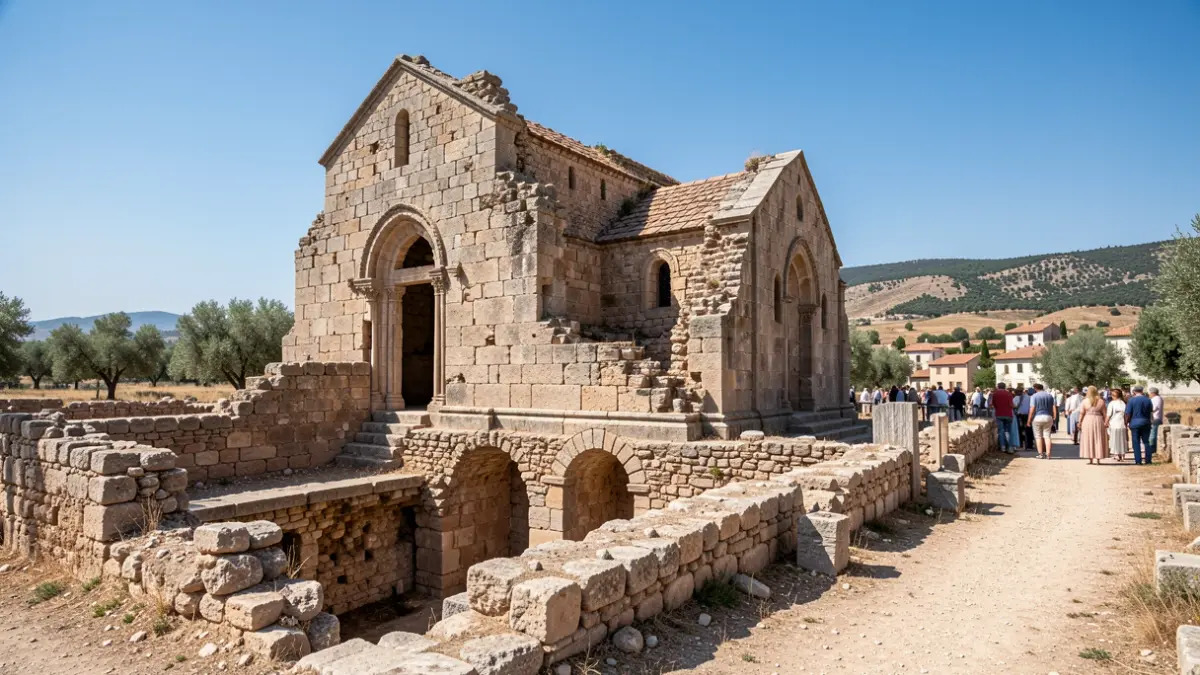
A preliminary architectural and archaeological study of the historical complex from the Romanesque period in Cunit, commissioned by the entity Delmacio de Conito and led by archaeologist Josep Maria Puche, suggests that the church of Sant Cristòfol might be older than previously believed.
Data obtained via ground-penetrating radar indicates the presence of remains from a building predating the Romanesque temple, particularly near the current apse. Although the existence of a prior church cannot yet be confirmed, researchers deem further investigation necessary through new studies and potential archaeological excavations.
This initiative is part of the four-year research project ‘Roots of Churches. Churches as Indicators of Early Medieval Settlement in Baix Penedès’, scheduled to run between 2026 and 2029. The pilot phase in Cunit began in 2024.
The project, supported by the Catalan Institute of Classical Archaeology (ICAC) and the School of Architecture of Rovira i Virgili University (ETSA-URV) in Tarragona, aims to study churches and hermitages from before the 12th century to understand the settlement patterns in Baix Penedès from late antiquity to the comital era.
Sant Cristòfol de Cunit, along with the church of Santa Magdalena de Bonastre, has served as a pilot case for developing the project's working methodology. The Romanesque church of Sant Cristòfol underwent significant transformations in the 17th century but retains a crucial part of its medieval origin: the original apse.
The apse's unique feature is its trefoil plan, an uncommon architectural configuration found in only 14 out of approximately 2,000 churches in Catalonia. This characteristic, coupled with the reuse of decorative elements, raised the possibility of an earlier construction history.
The investigation has identified remains with orientations different from those of the medieval constructions, suggesting potential earlier structures. However, researchers emphasize that geophysical prospecting alone cannot definitively determine the chronology or function of these anomalies, requiring archaeological confirmation.
A possible continuation of the north wall of the Romanesque building has also been detected, featuring a gap compatible with an access point. If confirmed, this could indicate a main entrance oriented towards the ancient communication route between Barcelona and Tarragona.
Finally, reused architectural decorative elements have been identified, which may originate from a construction predating the existing building.