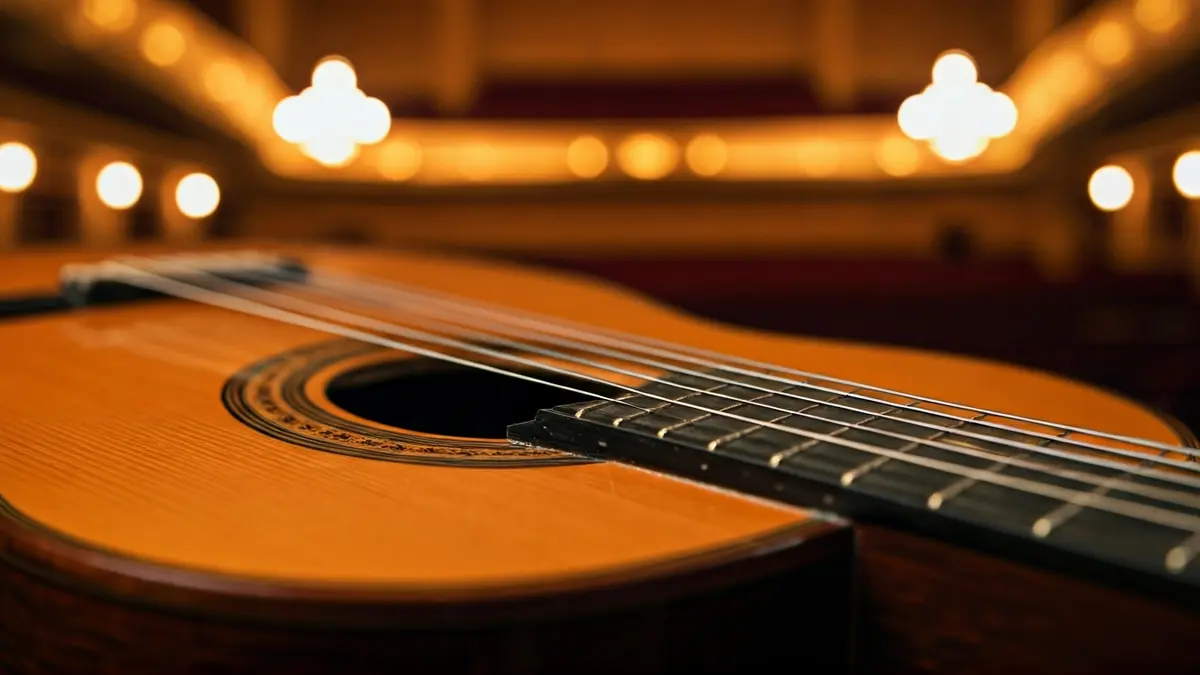
Alí Arango, a Cuban guitarist with a distinguished international career, has won twenty-three major awards in classical guitar. Despite this success, he considers himself an “atypical” artist due to his ability to fuse styles and his involvement in various artistic disciplines, including composition, music editing, photography, and graphic design.
With his group, the Barcelona Guitar Trio, Arango performs over forty times annually at the Palau de la Música Catalana and another sixty times worldwide, dedicating a third of his time to the stage. His demanding nature and rigor, which he attributes to his training in Cuba under a very strict “Soviet culture,” lead him to control all aspects of his artistic production.
“"I was born in Cuba, the son of visual artists. My mother and father were sculptors. In Cuba, I started making trouble – as they say there – because I wanted to be a rocker. In the end, all that's left of the rocker is my hair."
His arrival in Barcelona twenty years ago was the result of a creation scholarship in Córdoba with the Fundación Antonio Gala in 2005, followed by a visit to friends in the Catalan capital. An employment opportunity and his interest in international competitions led him to settle there permanently. Currently, his recording studio, family, and the Barcelona Guitar Trio are rooted in the city.
His decision not to return to Cuba after the scholarship resulted in the loss of his rights as a citizen, being considered a case of “abandonment of the mission.” This situation prevents him from returning to his native country except as a tourist, a reality he painfully experienced when he could not attend his mother's funeral. Arango expresses his concern about the current repression and crisis in Cuba, although he remains disconnected due to distance and the lack of direct family ties.
Regarding his musical vision, Arango laments the lack of knowledge about classical guitar in Spain and Catalonia, where he is often mistaken for a flamenco guitarist. He recognizes Paco de Lucía as a reference who opened flamenco to jazz and other genres, a philosophy he himself applies in his compositions and in the tribute show to Paco de Lucía that the Barcelona Guitar Trio presents at the Palau de la Música.
The guitarist also reflects on the impact of social media and superficiality in current music, even though his trio has a strong online presence with millions of views. He expresses concern about the normalization of vulgarity in genres like reggaeton and the loss of quality in popular music, contrasting it with the vitality and evolutionary capacity of modern jazz.