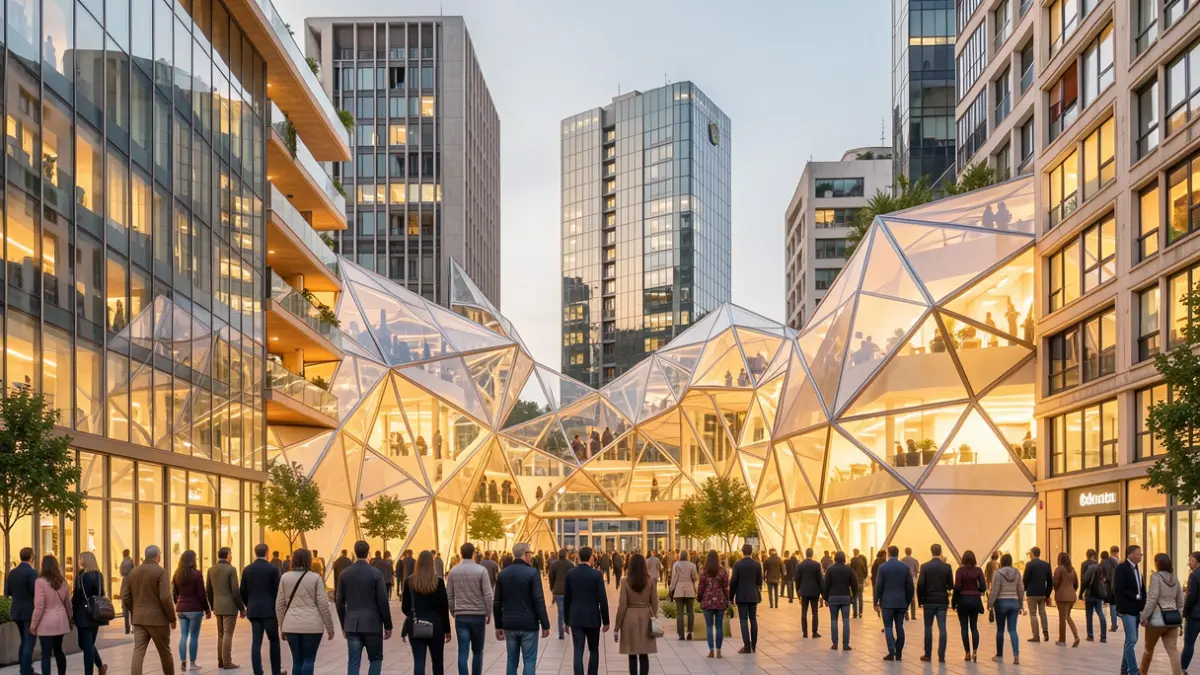
From November 3rd to 5th, the AMB is exhibiting its urban development projects at the Smart City Expo World Congress (SCEWC), framed within the Metropolitan Urban Planning Master Plan (PDUM). The objective is to showcase opportunity areas to address challenges such as housing access, improved habitability, decarbonization, and the promotion of a competitive and sustainable economy.
The AMB's Executive Vice-President and Mayor of Cornellà de Llobregat, Antonio Balmón, highlighted the work done in housing, stating that “the AMB is the Administration that has built the most housing in recent years”. He emphasized that “limiting housing prices is not to hit property owners, but those who speculate with these buildings”, defining it as “a long-distance race. It is urban transformation, social and moral progress”.
Balmón advocated for the AMB's management model to “humanize the territory” and stated that “without public power, there is only the jungle”. He emphasized the importance of public powers in enabling citizens' progress, assuring that “there is hope and a project”.
The metropolitan opportunity areas are strategic zones proposed by the PDUM to concentrate urban transformations that generate housing, economic activity, and new public spaces, linking growth to public transport and public space.
The first debate panel included the Mayor of Molins de Rei, Xavier Paz; the Second Deputy Mayor for Territory of the Badalona City Council, Daniel Gracia Álvarez; the AMB Manager, Ramon Torra; and the Head of the PDUM Drafting Service at AMB, Mireia Peris.
The second panel addressed climate change and its effects on the metropolis. Discussions focused on green infrastructure as a basis for reducing vulnerability and improving the efficiency of water cycle services, waste treatment, and energy generation. Participants included the Mayor of Santa Coloma de Gramenet, Mireia González; the Mayor of El Papiol and CEO of AMB's Natural Spaces, Jordi Bou; the Mayor of Sant Joan Despí and Vice-President of AMB's Water Cycle, Belén Garcia; and the CEO of AMB's Climate Action, Guille López.
On Wednesday, November 4th, the focus will be on how metropolitan opportunity areas integrate economic activities within a compact urban structure, ensuring proximity between population and workplaces, and an efficient public transport network. Future challenges include improving productivity, connecting markets, fostering investment, and accelerating the regeneration of industrial areas. Participants will include the Vice-President of the Social and Economic Development Area, Jordi Valls; the Mayor of Esplugues de Llobregat, Eduard Sanz; the Mayor of Sant Adrià de Besòs, Filo Cañete; and the Director of the AMB's Social and Economic Development Area, Ester Pujol.