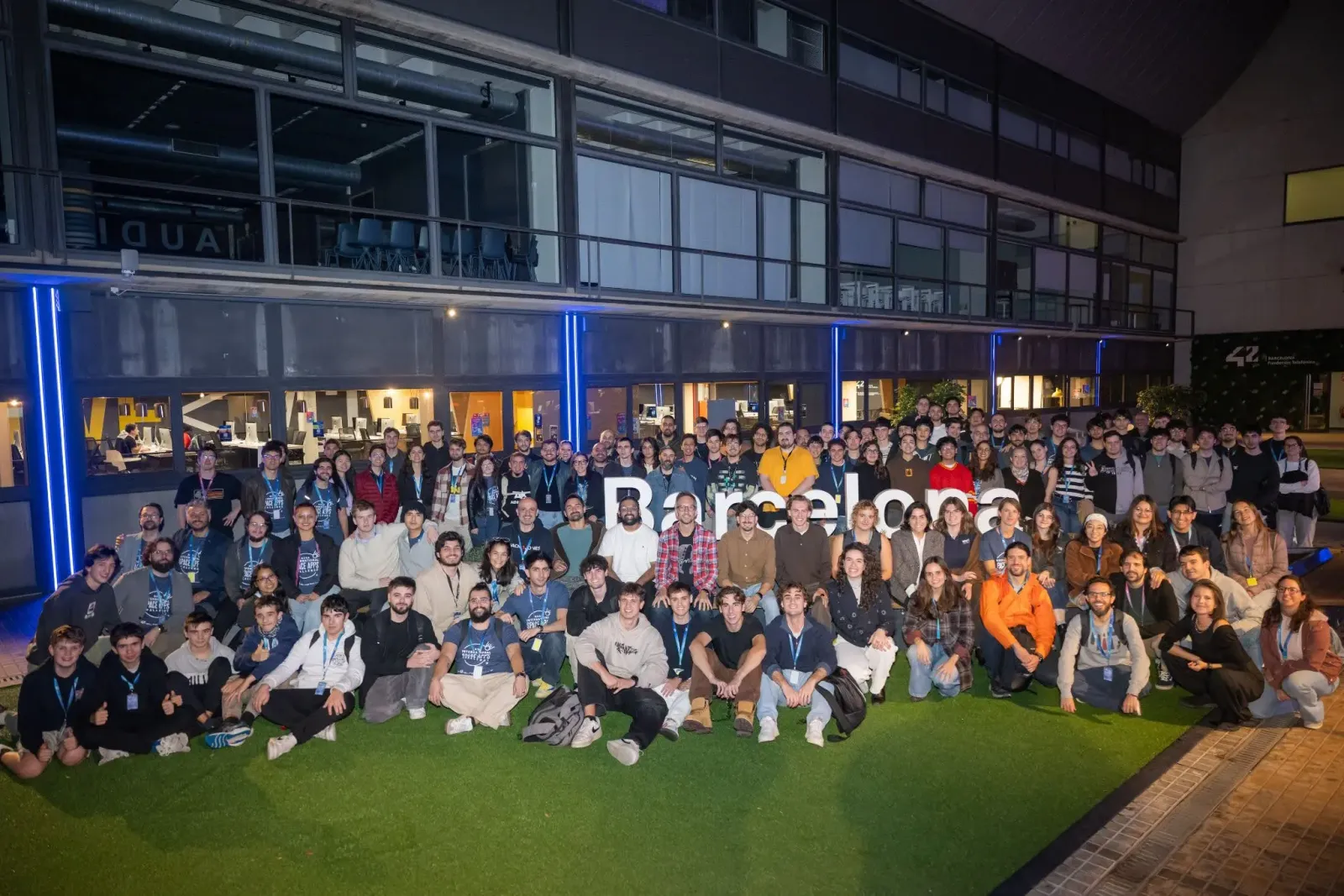
Throughout the weekend, the city has become a hub for technological innovation and scientific exploration with the NASA Space Apps Challenge. The event, organized by Space & Events with support from the Spanish Space Agency (AEE), the Government of Catalonia, the Catalan Institute for Space Studies (IEEC), and Barcelona Activa, brought together young people and professionals to develop solutions for extreme challenges in a 48-hour intensive work marathon.
Participants worked with NASA data, including satellite observations and predictive models. Proposals ranged from solutions for space exploration, such as algorithms for studying fire in microgravity or life support systems for lunar bases, to applications addressing terrestrial issues, like tools to combat drought, predict wildfires, or translate climate variables into sound.
The winning team, MJM, presented Orbitrack, a web application that uses NASA data to analyze how climate change affects the 13,426 kilometers of Spain's railway network. The tool identifies the most vulnerable sections to extreme heat, frost, and heavy rainfall, and assesses how these risks will evolve by 2050 and 2090 to assist railway managers.
The Barcelona edition saw 139 participants organized into 34 teams. Nationally, Spain led European representation at the NASA Space Apps Challenge 2026, with 1221 registered participants, accounting for 24% of the European Union's total and hosting 11 of the continent's 51 locations. This figure represents a 62% increase compared to Germany, the second-highest participating country.
Álvaro Montoliu, partner at Space Apps Spain, highlighted that the event allows participants to "prove their true potential when faced with extreme problems" and that "putting satellite data into the hands of passionate people is the best formula for awakening vocations and generating innovative proposals".
The Catalan Institute for Space Studies (IEEC), which promotes space research and technological development in Catalonia, was a key collaborator. The IEEC fosters local and global collaborations and serves as an efficient agent for knowledge, innovation, and technology transfer, with extensive experience in astrophysics, cosmology, planetary sciences, and Earth observation.