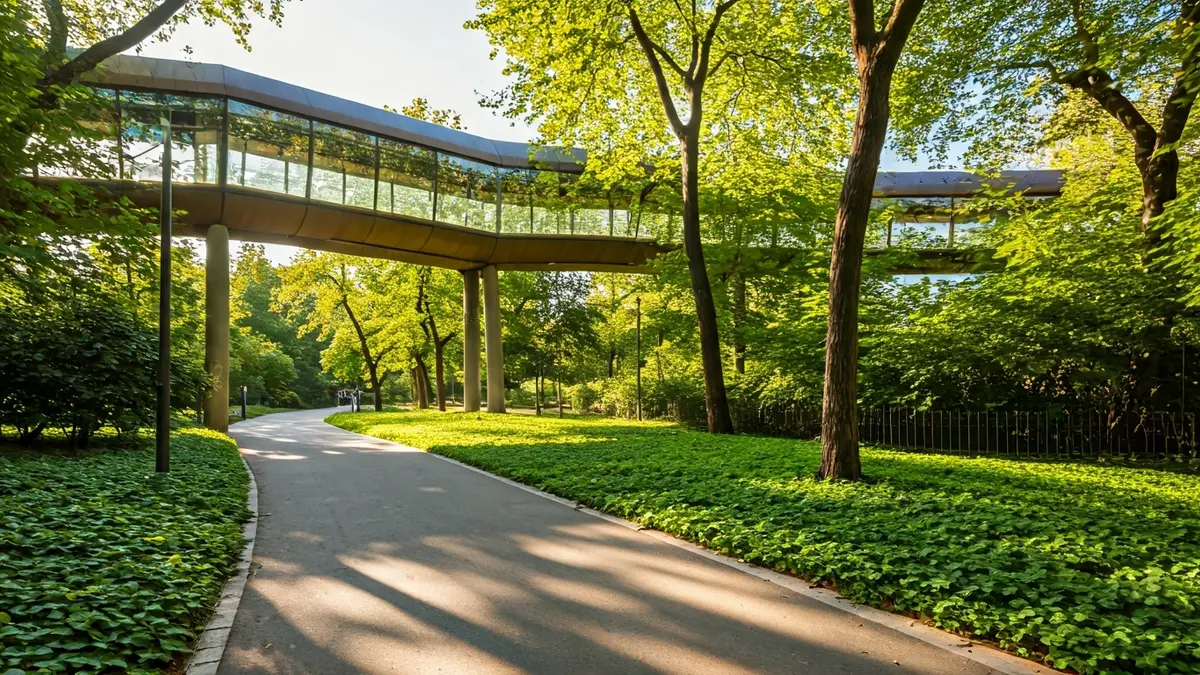
The long-awaited access to Ciutadella Park from Wellington Street is finally formalized this spring. Last Tuesday, the Barcelona City Council published the tender for the works, which will open a new pedestrian path through the Barcelona Zoo enclosure. This route, featuring an elevated walkway and an underpass, will connect to the Parliament of Catalonia and Joan Fiveller Square, where existing roads will be adapted in a second phase to link with Picasso Promenade. This initiative will end over 150 years of isolation, allowing pedestrians to travel between Sant Martí and Ciutat Vella without having to go around the historic park.
The executive project received approval from Jaume Collboni's government last January, and now the selection process for a construction company is open through a contract with the municipal company BSM. Interested companies have one month to submit their bids. The base budget without VAT exceeds 9.4 million euros, with an estimated total contract value reaching 11.3 million euros, pending proposals that may reduce the price.
The intervention will cover an area of 14,961 m², mostly within the Zoo, with a small strip of the park and a side of the Guàrdia Urbana stables. The execution period for the works is 17 months, placing its completion in late 2027 or early 2028, barring unforeseen circumstances. This represents a six-month delay compared to the initially announced schedule, preventing its inauguration before the municipal elections of 2027.
The tender documents detail that the works will involve the dismantling or adaptation of several Zoo facilities affected by the new promenade, such as the primate gallery and the habitats of the lesser grey shrike, the Iberian wolf, the bongo, the red panda, the dama gazelle, or the Chilean flamingos. The enclosure is already undergoing a transformation phase, with new habitats and educational spaces planned until 2030, including the future immersive Bioscope center.
The tender also includes an animal welfare protocol, dated February 2026, which stipulates that any work in the Zoo must consider the animals' sensitivity to vibrations, sound frequencies, chemical odors, and noise. Therefore, an impact study is required before the start of any work, supervised and endorsed by the zoo's management, with whom any significant impact must be coordinated at least 15 days in advance. Furthermore, an Excel sheet with all planned works for the next seven days must be submitted every Wednesday to apply appropriate mitigation measures.
This new access is crucial for the expansion of the Parliament of Catalonia, located in the center of the park. The promenade will connect the current Palau with the new annex building, which will be located in the current Guàrdia Urbana stables. Parliamentary sources estimate the completion of the Catalan Chamber's project in about eight years, but the Parliament will first need to find a provisional alternative for its parking, which currently has about 200 spaces in Joan Fiveller Square, precisely the destination point of the now-tendered Wellington access.
“"The walkway, which will open next year, will be the first significant change for the future expansion of the Parliament."
The original project by Josep Fontseré for the park in the late 19th century already envisioned a promenade from Wellington to Picasso, but half of the route was eliminated in the 1950s to expand the Zoo. The recovery of this access has been a technical and political challenge, having been in limbo for over a decade. Although no specific entity led the demand, the student and teaching community of the Universitat Pompeu Fabra (UPF) and the Vila Olímpica neighborhood widely supported it.
The work was first announced by former mayor Xavier Trias, who even detailed that it would be named after primatologist Jordi Sabaté Pi. However, the project was shelved in 2014 due to opposition from the Zoo's works council and the support of six neighborhood associations, including the FAVB. During Ada Colau's two terms, the Zoo generated many headlines, not for its perimeter, but for the thorny development of a strategic plan agreed upon by parties, workers, scientists, and animal welfare groups.
With this new roadmap underway and a different political climate at the Zoo and in the city, Barcelona Regional drafted a new Master Plan for Ciutadella Park in 2023 and the Barcelona Zoo Master Plan in 2024, which paved the way for the park's opening via Wellington. In January 2025, Jaume Collboni announced the project's revival as part of the ongoing relaunch of the park and its surroundings as a hub for research and culture. This objective, shared by major public and scientific institutions, includes various actions, from rehabilitating the Castell dels Tres Dragons to building a pioneering precision medicine center on the site of the former Mercat del Peix.