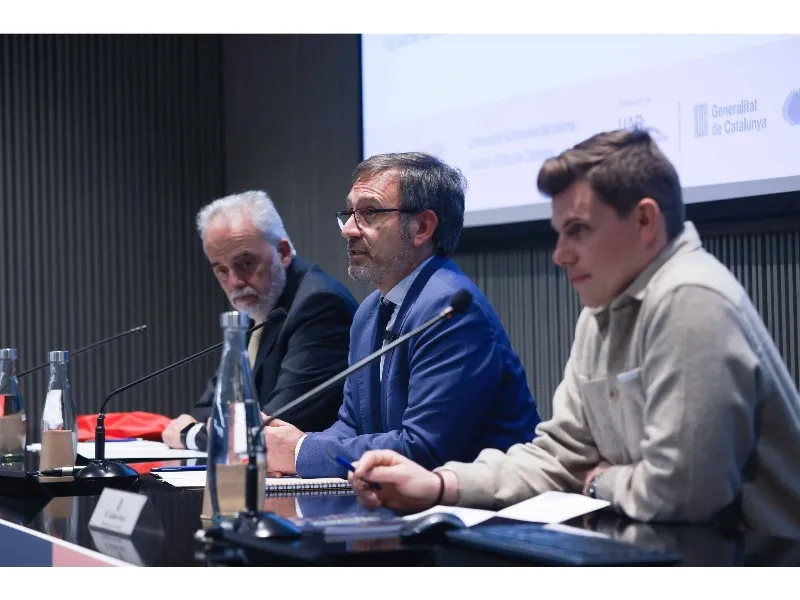
The conferences highlighted the need to move from diagnosis to action to reinforce Catalan usage. Key working lines include improving teacher training, adopting pedagogical strategies to foster peer interactions in Catalan, revitalizing language use in playgrounds and dining halls, and strengthening the connection between university research and educational practice. The involvement of the entire educational community and families was also emphasized.
The Minister of Linguistic Policy, F. Xavier Vila, advocated for a "third renewal of the educational linguistic model," adapting the principles of immersion from the 80s and 2000s to current circumstances. He stressed peer interaction as a priority to create conditions for Catalan to be the language of daily relationships.
Professor Mireia Galindo presented data showing a decline in Catalan use among peers, particularly among adolescents. According to a 2021 study by the Ombudsman, Catalan is the language of classroom interaction for 50.9% of 5th graders, dropping to 38.8% in 3rd year of ESO, and 32.2% in playgrounds. Galindo underscored the school's crucial role as an access point to the language for many young people.
Professor Llorenç Comajoan discussed immersion models and current challenges, focusing on the need for concrete pedagogical interventions, teacher training, and evaluable strategies for oral Catalan use. Lurdes Malgrat, head of the Linguistic Support and Resources Service, outlined current actions and future challenges, including consolidating Catalan as a vehicular and learning language.
Professor Isabel Rios advocated for creating joint reflection spaces among teachers, administration, and university staff to enhance teachers' linguistic and didactic competencies. Experiences from schools in Barcelona, Vic, and Palma, such as 'glosa' and playground activities, were presented.
On its 50th anniversary, La Bressola shared its language immersion methodology, combining mixed ages and cooperative pedagogies, to make Catalan a language of spontaneous use. President Guillem Nivet summarized: "We don't want immersion to know the language, we want immersion to live Catalan. To win the language."
International experiences were also presented, including those from the Calandretas in Occitania and the Semente schools in Galicia, which emphasize community building for living minority languages. The experience from Wales in welcoming and immersion strategies for English-speaking families was also shared.
The Secretary General of Linguistic Policy, Joan Santanach, concluded the conferences by noting that "immersion is not a static model" and that "we are not starting from scratch." He positively valued the exchange of experiences to face the future with "ambition for improvement."