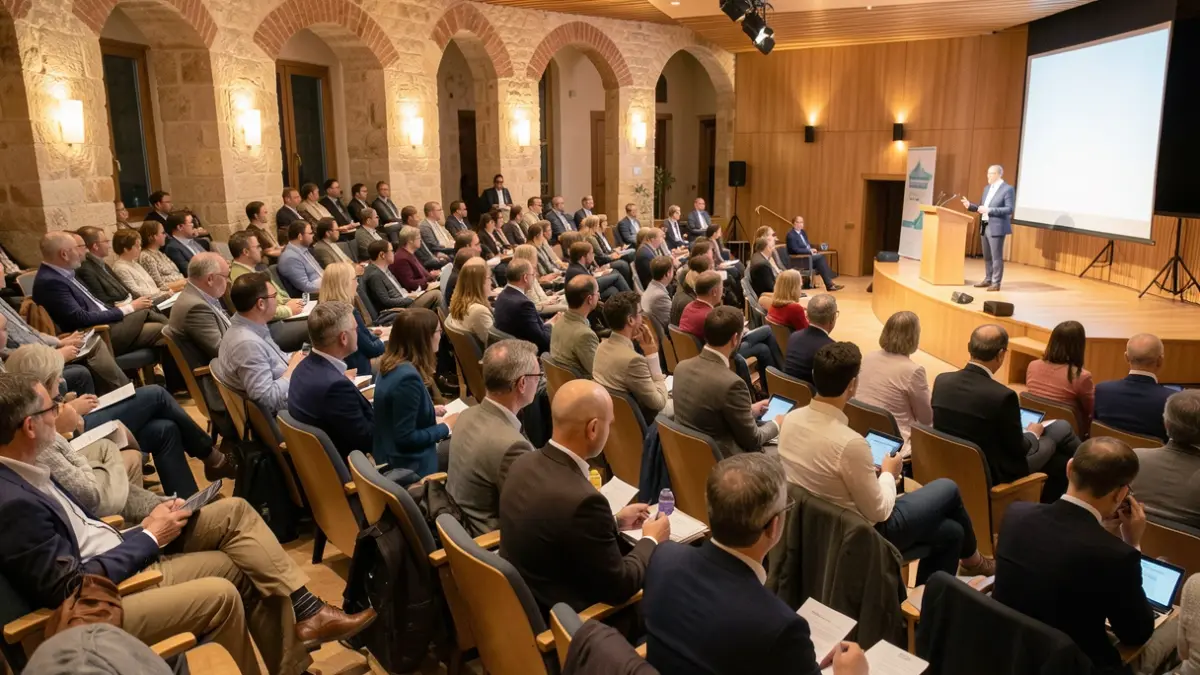
The event was attended by Núria Montserrat Pulido, Minister of Research and Universities of the Government of Catalonia; Rosa María Sebastián Pérez, Vice-Rector for Innovation, Knowledge Transfer and Entrepreneurship at the UAB; Teresa Sanchis, Director General for Research; Laia Pellejà, Director of the Institució CERCA; Andreu Mas-Colell, President of BIST; Eduard Vallory, Director of BIST; and Ramon Pascual, former UAB rector and driving force behind IFAE's creation. Also present were the current IFAE Director, Eugenio Coccia, and the Director-designate, Mario Martínez Pérez, along with former directors and representatives of partner institutions.
In his opening address, IFAE Director Eugenio Coccia described the institute through three values: passion, collaboration, and responsibility, reflecting on the collective effort during his four years in charge. "What truly defines the institute is its people: their talent, their dedication, and their ability to work together, day after day," he stated.
Minister Núria Montserrat Pulido highlighted IFAE's role in making Catalonia an active contributor to international science, calling for sustained support for fundamental research. "We cannot predict the future of science, but we can decide what role we want to play in building it," she remarked.
UAB Vice-Rector Rosa María Sebastián Pérez emphasized the institute's university roots and its ongoing collaboration in research, training, and technology transfer. "We celebrate the achievements of an institution we helped create, which has its roots in our university and with which we continue to share people, training, spaces, and projects," she said, reaffirming the UAB's commitment to IFAE's future, including its work on the Einstein Telescope.
Under the title "Images for the future," members from IFAE's research groups, Technical Division, and Scientific Information Port (PIC) presented the institute's work through images and short interventions, illustrating the scientific questions, instruments, and collaborations connecting its various activity areas. The relationship between scientific ambition and the necessary technologies was explored, as were the applications of fundamental research in fields like medicine and quantum technologies.
Laia Pellejà, Director of Institució CERCA, highlighted IFAE's four contributions to Catalonia: attracting talent, transforming research into economic activity through spin-offs, sharing technical infrastructure, and inspiring future generations. She encouraged greater interdisciplinary collaboration.
A round table explored IFAE's impact through the experiences of Víctor Canivell (Qilimanjaro Quantum Tech), Lluís Miralles (CERN), Marc Andrés Carcasona (MIT Kavli Institute), and Martine Bosman (IFAE emeritus professor), offering perspectives on the institute's contribution to research, engineering, and entrepreneurship.
Ramon Pascual recalled the institute's university origins and its rapid development. A video featuring the first three directors revisited the ambition behind its creation. Mario Martínez Pérez, who will succeed Eugenio Coccia as director on November 1, 2026, outlined priorities for the next stage, including international scientific leadership, support for young researchers, and contributions to major projects like the Einstein Telescope and the Future Circular Collider.
Andreu Mas-Colell, President of BIST, concluded by recalling how IFAE demonstrated that research centers could be organized differently, attracting international talent and combining theory with technology.
IFAE, founded in 1991 as a consortium of the Government of Catalonia and the Universitat Autònoma de Barcelona, is a CERCA center and a member of BIST. It has received Severo Ochoa Centre of Excellence accreditation multiple times. Its activities combine theoretical and experimental research in particle physics, astrophysics, and cosmology, with applications in medicine and quantum computing.