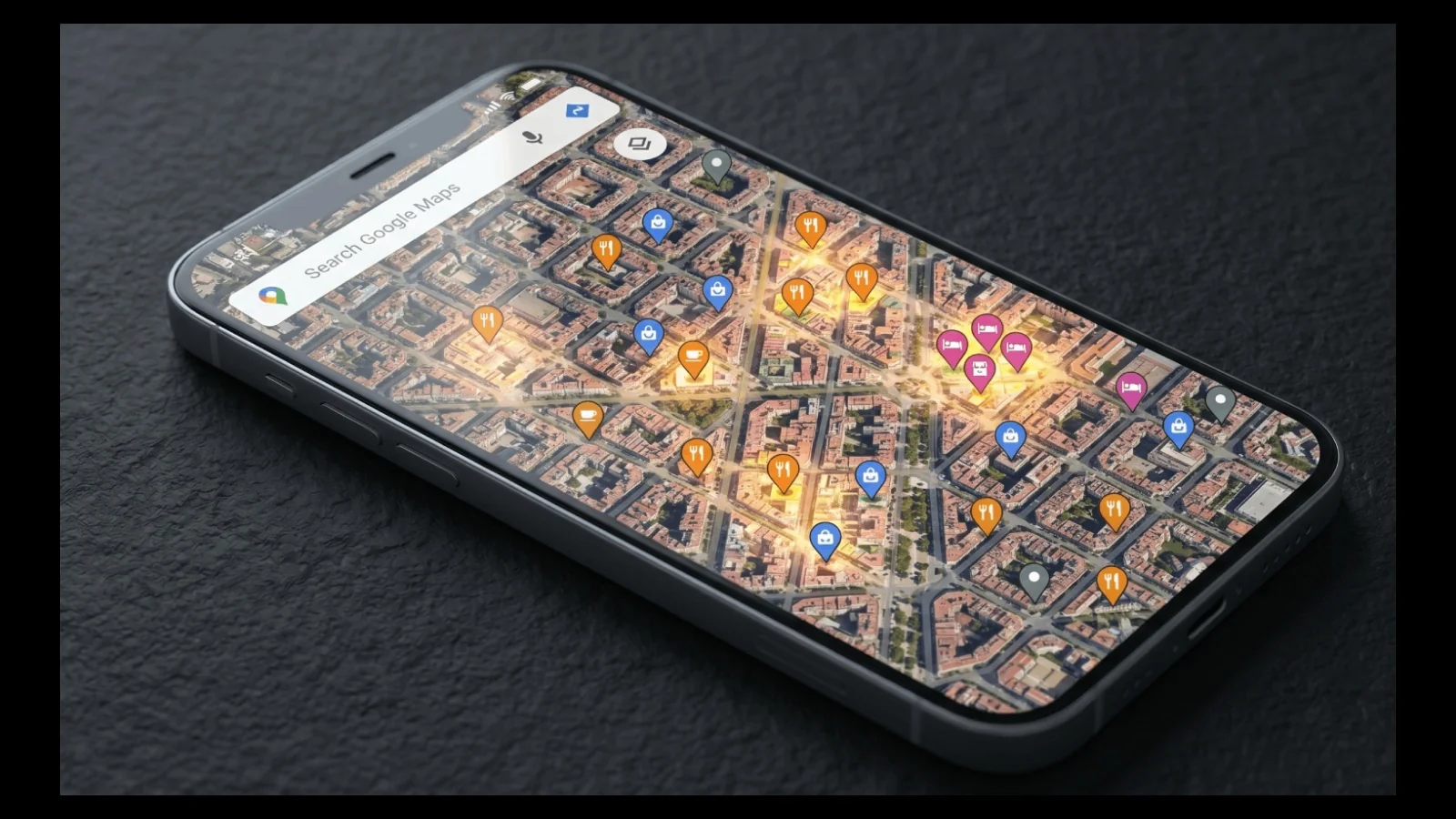
The Barcelona invisible to Google exists: thousands of local businesses that fill the streets but don't appear on the map or on potential customers' phones. It's a reality that, even when they have a Google listing, a significant portion of SMEs haven't claimed or verified it, leaving the management of their digital "business card" in the hands of third parties – or the algorithm itself. Not having control of the listing means being unable to correct erroneous data, respond to reviews, or access visibility and call statistics. And, above all, it means missing a great opportunity to reach people who are looking for exactly that product or service.
In a dense and competitive city like Barcelona, where the "near me" search has become a daily gesture, Google Maps and the local pack have transformed into the new commercial storefront.
According to various recent studies on search behavior, around 46% of all searches on Google have local intent: people looking for a service or product near where they are, such as "physiotherapist Barcelona" or "Gracia hairdresser".
The trend is rising due to the massive use of mobile devices and the convenience of searching from a phone. But the most revealing data is that between 76% and 88% of local searches made from a mobile device end in a physical visit or a call to the business within 24 hours.
According to various recent studies on search behavior, around 46% of all searches on Google have local intent: people looking for a service or product near where they are, such as "physiotherapist Barcelona" or "Gracia hairdresser".
The trend is rising due to the massive use of mobile devices and the convenience of searching from a phone. But the most revealing data is that between 76% and 88% of local searches made from a mobile device end in a physical visit or a call to the business within 24 hours.
In this scenario, the importance for local businesses of having an optimized, updated, and well-maintained Google Maps listing becomes clear, ensuring it's visible precisely to those looking for that product or service in their area.
Local positioning – or local SEO – is the branch of SEO, within the digital marketing discipline, that aims to make a business appear when someone performs a search with a geographic component. Erica Scarná, a Barcelona-based SEO consultant and founder of Erica Web Lab, explains that local SEO "operates within a specific geographic radius and has much more direct effects on sales: the user who searches usually wants to book, call, or visit the place the same day".
Local positioning – or local SEO – is the branch of SEO, within the digital marketing discipline, that aims to make a business appear when someone performs a search with a geographic component. Erica Scarná, a Barcelona-based SEO consultant and founder of Erica Web Lab, explains that local SEO "operates within a specific geographic radius and has much more direct effects on sales: the user who searches usually wants to book, call, or visit the place the same day".
Scarná confirms that it is possibly one of the areas of organic positioning that can yield results fastest for a small or medium-sized business. According to the consultant, to succeed in local positioning – especially in cities as dense with local businesses as Barcelona and in the current landscape marked by artificial intelligence – the key is to create a solid synergy between the company's website, the Google Business Profile listing, and other channels such as social media, portals, and directories.
“"The trend I see in SMEs – Scarná comments – is to invest in having a beautiful website and running paid campaigns on Google, but the Google listing is left half-done, and local SEO isn't considered a continuous project. When this channel, if worked well, could be much more profitable than paid ads and more effective than an SEO strategy focused only on the website."
In fact, in this new landscape, where AI-powered search and generative results are changing user behavior when looking for a service, a multi-platform strategy is consolidating as the only way to gain visibility, be cited by generative search engines, and attract better clients.
Consultants specializing in local SEO are well aware of the reality of neighborhoods, the differences in competition between areas, and the specific search habits of local residents. "The goal isn't just to 'appear on Google,' but to translate that visibility into calls, visits, and repeat customers," Scarná summarizes.
Consultants specializing in local SEO are well aware of the reality of neighborhoods, the differences in competition between areas, and the specific search habits of local residents. "The goal isn't just to 'appear on Google,' but to translate that visibility into calls, visits, and repeat customers," Scarná summarizes.
The consultant insists that the phase prior to implementing a local positioning strategy is crucial: "You need to understand the company, its values, its audience, the geographic area, and its direct competition. Only then can you design a local presence that is coherent, sustainable over time, and truly useful for the business. Beyond working on SEO, a local positioning specialist becomes a true partner to the business, delves into the entrepreneur's daily dynamics, and aligns the digital strategy with their real objectives."