
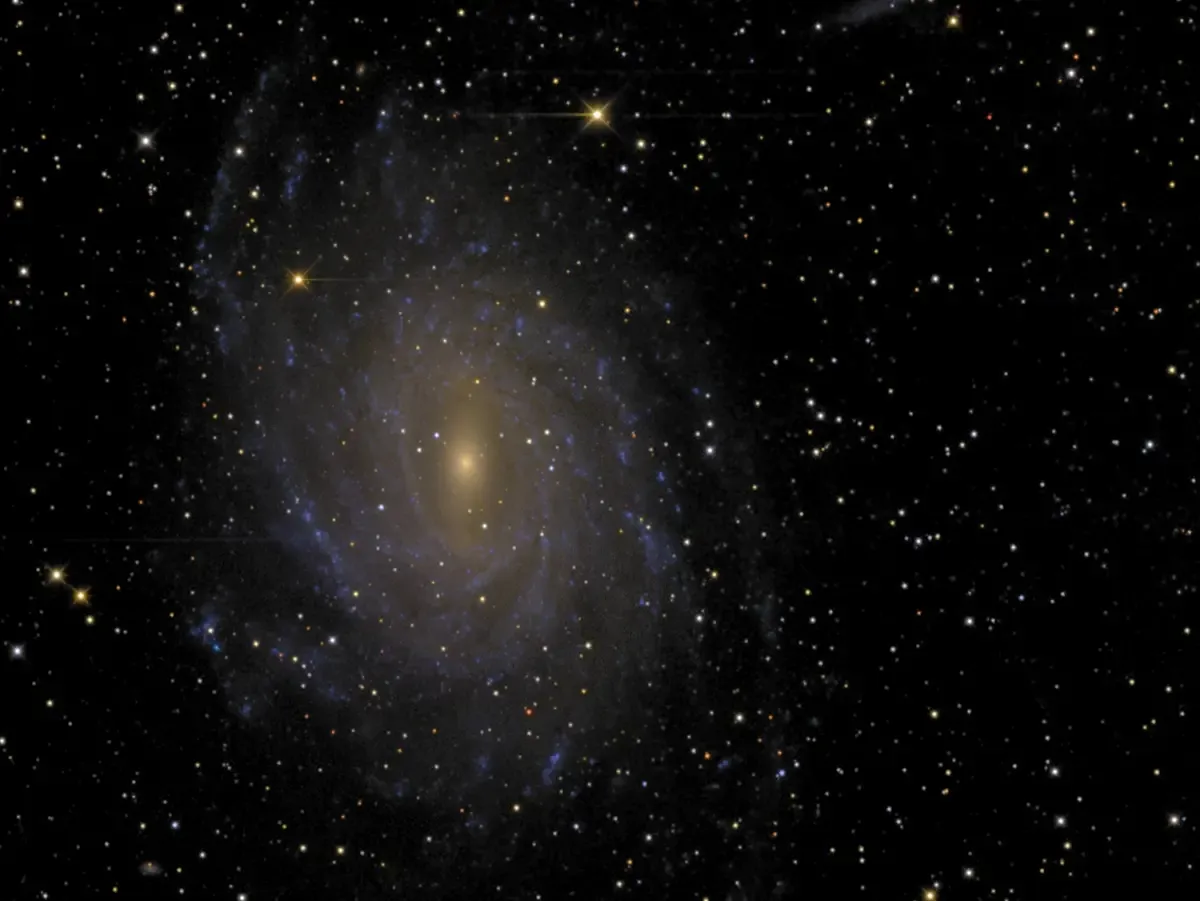
The study, led by Professor Avishay Gal-Yam of the Weizmann Institute of Science (Israel), analyses supernova SN 2024vjm, discovered in galaxy NGC 6744 approximately 30 million light-years away. The findings, published today in the journal Nature Astronomy, challenge an astrophysical law maintained for over 30 years: the principle known as the Phillips relation, which predicts that faint supernovae fade quickly.
The supernova was detected by the sky survey BlackGEM, a project operational in the Atacama Desert (Chile) since 2023. PhD student Erez Zimmerman, from Gal-Yam's group, explains that peak brightness was reached within a few days or weeks, but its fading was extraordinarily slow. Unlike ordinary supernovae, where gas expands at 10,000 kilometres per second, here the cloud moved at only 3,000 kilometres per second.
The researchers determined that the explosion was caused by a binary system of small, dim stars: a white dwarf and a tiny companion star, or perhaps a pair of white dwarfs. This weakness prevented the gas from becoming thin enough for radiation to escape until more than 70 days had passed, keeping the supernova visible much longer than expected.
Professor Nadejda Blagorodnova, principal investigator of the IEEC research group at the Institute for Cosmos Sciences of the University of Barcelona (ICCUB), led the observation proposal that obtained a spectrum of the supernova using the X-shooter spectrograph at the Very Large Telescope (VLT). This observation was key to revealing the unusually slow expansion of the gas. The group also contributed to the development of tools for detecting this transient phenomenon in BlackGEM data.
The article titled «A Faint Progenitor System for the Faint Supernova 2024vjm», authored by Avishay Gal-Yam, Erez A. Zimmerman, and others, is published on 26 November 2026. This study provides a roadmap for observations that will leverage new technologies to uncover the secrets of exploding stars.